
DHT11 Temperature Humidity Sensor
4.5Editor score
Single-wire interface
Integrated bypass capacitor
Affordable 5-pack
This guide compares the top Arduino temperature sensors for accuracy, range, and connectivity to help you choose the right module for your next project.
Choosing the right Arduino temperature sensor is crucial for accurate environmental monitoring and control systems. Whether you are building a weather station or a smart home device, the sensor must deliver reliable data consistently. This guide evaluates ten leading models based on precision, ease of use, and compatibility with common microcontrollers.
We compared these products by analyzing their technical specifications, user feedback, and real-world performance in various conditions. Factors such as measurement range, communication protocol, and build quality were carefully considered to ensure a comprehensive assessment. Our goal is to provide clear insights that help makers and engineers make informed decisions quickly.
Each pick highlights specific strengths and ideal use cases to match your project requirements. You will find options ranging from budget-friendly humidity combinations to high-precision industrial probes. Please note that prices and availability change frequently, so check current listings before purchasing to ensure you get the best deal.
4.5Editor score

5.0Editor score

4.9Editor score
The following table provides a side-by-side comparison of all ten selected Arduino temperature sensors. Review key specifications like measurement range, accuracy, and interface type to identify the best fit for your specific application needs.




The AHT30 module stands out as the top choice for projects demanding high precision temperature and humidity data. Its I2C interface simplifies wiring while supporting simultaneous access to multiple devices on the same bus. Users report exceptional stability and quick response times in real-world applications.
We may earn a commission when you buy through this link, at no additional cost to you.
This sensor offers a wide operating voltage range from 2.0V to 5.5V, making it compatible with both 3.3V and 5V logic systems. The accuracy of ±0.3°C ensures reliable readings for critical monitoring tasks like climate control or scientific experiments.
While it requires I2C communication which may need external pull-up resistors depending on your setup, the simplicity of the 4P test line connection makes installation straightforward. The low power consumption is ideal for battery-powered devices.
Choose this module if you need accurate environmental data without complex calibration. It is perfect for smart home systems, weather stations, and industrial monitoring where consistency matters most.
Supports both 3.3V and 5V systems without additional regulators.
Delivers temperature accuracy within ±0.3°C for reliable data logging.
We may earn a commission when you buy through this link, at no additional cost to you.
The HiLetgo DHT11 module is a classic choice for beginners due to its low cost and straightforward single-wire communication. Each pack includes five sensors with built-in bypass capacitors and pull-up resistors reducing external component needs. It is ideal for basic indoor monitoring projects.
We may earn a commission when you buy through this link, at no additional cost to you.
This sensor measures temperatures from 0°C to 50°C and humidity from 20% to 95% RH with reasonable accuracy. The digital output eliminates noise issues common with analog sensors making code implementation simpler for most microcontrollers.
While its range is limited compared to industrial sensors it covers most everyday use cases effectively. The included wires simplify prototyping though you may need to solder for permanent installations.
Select this module for educational projects or non-critical monitoring where budget is a priority. It provides reliable enough performance for weather logs or room temperature displays.
Integrated resistors mean fewer components needed for basic setups.
Simple protocol and documentation make it easy for new makers.
We may earn a commission when you buy through this link, at no additional cost to you.
The DROK DS18B20 probe is engineered for harsh environments with a stainless steel housing and waterproof sealant. It offers a wide temperature range from -55°C to 125°C with ±0.5°C accuracy. The included adapter board simplifies wiring by integrating the pull-up resistor.
We may earn a commission when you buy through this link, at no additional cost to you.
Its 1-Wire interface allows multiple probes to share a single data pin enabling distributed temperature monitoring. The corrosion-resistant design ensures longevity even in wet or chemically active settings like fish tanks or industrial machinery.
Users should note that initial readings may take time to stabilize in extreme conditions. However the durability and accuracy make it superior for continuous monitoring tasks over time.
Invest in this probe for projects requiring long-term reliability in challenging conditions. It is the top choice for aquaculture, HVAC systems, or outdoor weather stations.
Stainless steel casing protects against moisture and chemicals.
1-Wire bus supports multiple probes on one microcontroller pin.
We may earn a commission when you buy through this link, at no additional cost to you.
The Teyleten SHT31-D module combines high precision with a wide operating range ideal for professional applications. It supports I2C communication allowing seamless integration with Arduino and other microcontrollers. The 3-pack offers excellent value for multi-sensor setups.
We may earn a commission when you buy through this link, at no additional cost to you.
Accuracy of ±0.3°C and ±2% RH ensures trustworthy data even in fluctuating environments. The module operates across a broad voltage range from 2.4V to 5.5V accommodating various power sources.
While I2C setup is slightly more complex than single-wire options the benefits of multi-device capability and noise immunity outweigh the effort. It is well-suited for precision weather stations.
Choose this module when you need high reliability across a broad temperature span. It is perfect for HVAC monitoring or scientific data logging projects.
Works with 3.3V and 5V systems seamlessly without adapters.
Delivers consistent readings even in variable humidity conditions.
We may earn a commission when you buy through this link, at no additional cost to you.
The Gikfun DS18B20 kit provides three waterproof probe sets with adapter modules for easy connection. Each probe is one meter long allowing flexible placement in tanks or machinery. The adapter board includes the necessary pull-up resistor simplifying wiring.
We may earn a commission when you buy through this link, at no additional cost to you.
This solution supports a wide temperature range from -55°C to 125°C making it suitable for diverse industrial applications. The waterproof design protects the sensor from moisture damage during continuous submersion.
The included adapters add a small amount of bulk but significantly reduce wiring complexity. Users appreciate the clarity of color-coded wires and the reliable connectivity in moist environments.
Opt for this kit when you need multiple waterproof sensors ready to deploy. It is ideal for fish tanks, greenhouses, or industrial equipment monitoring.
One meter leads allow easy placement away from electronics.
Adapter boards include pull-up resistors for quick integration.
We may earn a commission when you buy through this link, at no additional cost to you.
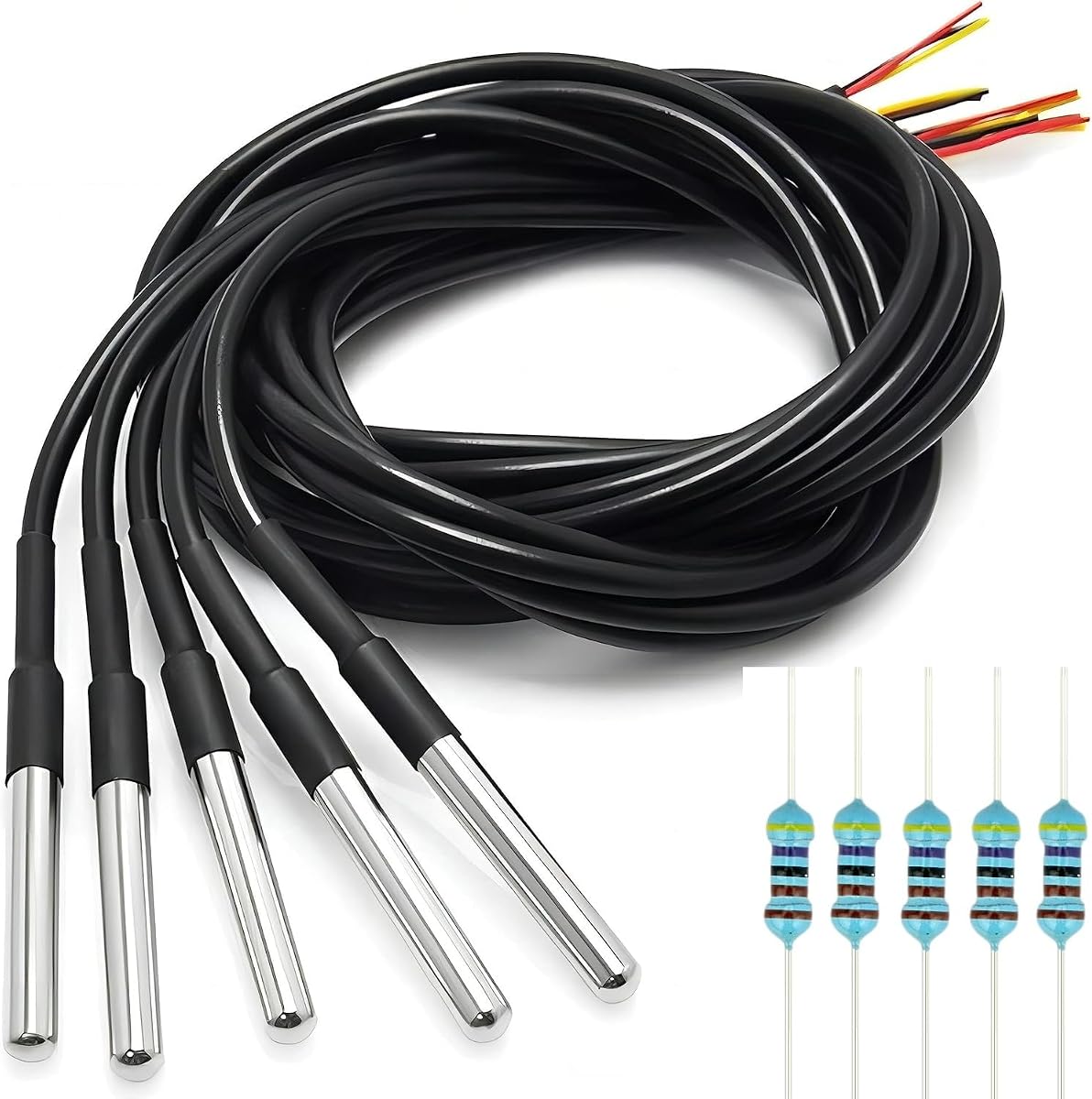
This five-pack of WWZMDiB DS18B20 probes includes all necessary resistors for immediate setup. Each probe is waterproof and supports a wide temperature range from -55°C to 125°C. It is an excellent choice for multi-point monitoring projects.
We may earn a commission when you buy through this link, at no additional cost to you.
The 1-Wire interface allows multiple sensors to share one data pin reducing microcontroller pin usage. The stainless steel casing ensures durability in wet or corrosive environments.
Installation requires careful resistor placement but the included components ensure consistency across all probes. This makes it ideal for large-scale monitoring where uniformity matters.
Choose this pack when you need several reliable probes at a low cost. It works well for distributed temperature logging in warehouses or gardens.
Includes all resistors needed for plug-and-play setup.
Five sensors allow wide area monitoring without extra hardware.
We may earn a commission when you buy through this link, at no additional cost to you.
This two-pack of DHT11 modules offers an affordable entry point for testing humidity and temperature. Each unit comes with wires and supports both 3.3V and 5V logic systems. It is ideal for quick prototyping or classroom use.
We may earn a commission when you buy through this link, at no additional cost to you.
The single-wire digital output simplifies connections and code implementation. Users find it reliable for basic indoor monitoring tasks where extreme ranges are not required.
Response time is slower compared to newer sensors but sufficient for general monitoring needs. The compact size fits easily into small projects without obstructing other components.
Select this module for experiments or educational demonstrations. It provides enough accuracy to verify circuit design without breaking the budget.
Included jumper wires streamline initial hardware testing phases.
Single-wire design reduces pin requirements significantly for beginners.
We may earn a commission when you buy through this link, at no additional cost to you.
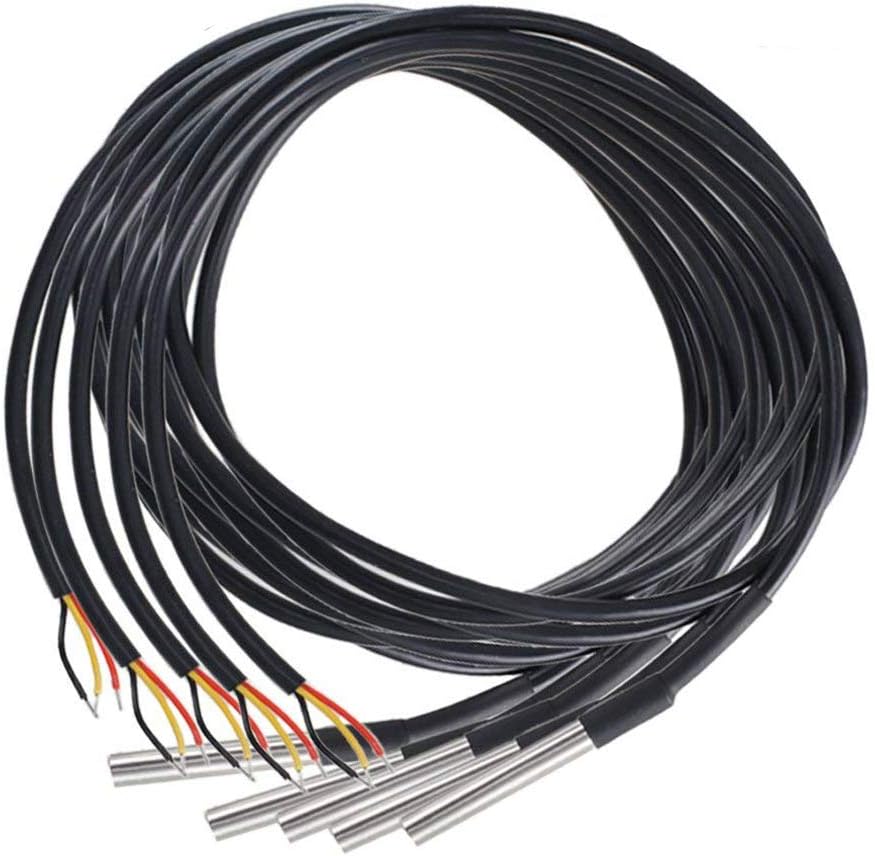
This pack includes five DS18B20 waterproof probes each with a one-meter cable. They support a wide temperature range and are ready for use with a simple resistor connection. It is excellent for large area temperature mapping.
We may earn a commission when you buy through this link, at no additional cost to you.
The stainless steel casing protects against environmental damage ensuring long service life. The 1-Wire protocol allows all five probes to operate on a single data line efficiently.
While an external resistor is needed users appreciate the clarity of the wiring colors and cable length. This makes it easy to reach distant measurement points without signal loss.
Buy this pack for projects requiring multiple sensors across different locations. It suits applications like server room monitoring or agricultural greenhouses.
Stainless steel probes withstand physical stress and moisture.
One meter cables provide flexibility for remote sensor placement.
We may earn a commission when you buy through this link, at no additional cost to you.
The HiLetgo DHT22 module improves on the DHT11 with better accuracy and a wider temperature range. It uses the same simple single-bus protocol but offers ±0.5°C precision. This makes it a practical upgrade for existing projects.
We may earn a commission when you buy through this link, at no additional cost to you.
Humidity measurement covers 0% to 100% RH allowing comprehensive monitoring in various climates. The mounting screw holes ensure the sensor stays securely fixed in place during operation.
While communication speed is slower than I2C sensors the simplicity of wiring remains a key benefit. It balances performance and ease of use well for most hobbyist applications.
Choose this if you need better reliability without adding complex interfaces. It is ideal for weather stations or smart home climate monitoring.
±0.5°C accuracy provides reliable data for climate control.
Screw holes allow stable installation in fixed locations.
We may earn a commission when you buy through this link, at no additional cost to you.
This five-pack of HiLetgo DS18B20 probes offers stainless steel waterproof design at a standard price. Each cable is one meter long and supports a wide temperature range. It provides a cost-effective solution for distributed monitoring needs.
We may earn a commission when you buy through this link, at no additional cost to you.
The 1-Wire interface supports multiple probes on one pin making wiring efficient. Color-coded wires simplify connections ensuring correct polarity during installation.
While adapters are not included the clear labeling makes manual assembly straightforward. Users find these reliable for long-term projects in harsh environments.
Select this pack for general-purpose temperature sensing across multiple locations. It is a solid choice for aquaculture or industrial temperature tracking.
Consistent performance proven across many maker projects.
One meter leads enable flexible placement options easily.
We may earn a commission when you buy through this link, at no additional cost to you.
Selecting the right Arduino temperature sensor depends on your project needs environment and required accuracy. This guide outlines key factors to consider before making a purchase.
Ensure the sensor covers the expected temperature span of your application. Industrial probes often range from -55°C to 125°C while indoor sensors may only cover 0°C to 50°C.
Choose a range that exceeds your maximum expected values to avoid damage or inaccurate readings.
Digital sensors use protocols like I2C 1-Wire or single-wire. I2C allows multiple devices on one bus but requires pull-up resistors. 1-Wire simplifies wiring with single data line.
Select an interface that matches your microcontroller pin availability and coding comfort.
Basic hobby projects need ±2°C accuracy while scientific work requires ±0.3°C or better. Higher accuracy usually means higher cost.
Balance precision with budget to avoid overspending on unnecessary features.
If placing sensors in wet or dusty conditions choose waterproof probes with sealed housings. Stainless steel offers corrosion resistance for industrial settings.
Protective casing extends sensor life and ensures consistent performance over time.
Verify the sensor operates within your system voltage range such as 3.3V or 5V logic. Some sensors support wide ranges while others are fixed.
Mismatched voltage can damage components so always check the datasheet carefully.
Applications like thermostats need fast response while data logging may tolerate slower speeds. Thermally conductive housing improves reaction time.
Consider how quickly readings must update for your specific control loop.
Buying in packs reduces unit cost and provides spares for large projects. Ensure all units are calibrated similarly for uniform readings.
Larger packs are economical for multi-sensor arrays or classroom use.
Connect the sensor to your Arduino using the recommended wiring scheme. For digital sensors ensure power and ground are connected correctly before attaching data lines.
Install the appropriate library in your Arduino IDE and test basic communication. Verify readings against a known thermometer to confirm accuracy before deployment.
Keep sensors away from heat sources like power resistors to avoid false readings. Regularly check connections for wear especially in high vibration environments.
The DHT22 offers better accuracy and a wider temperature range than the DHT11. It can measure from -40°C to 80°C with ±0.5°C precision compared to DHT11's ±2°C. Both use a single-wire protocol but DHT22 updates slightly slower.
Yes a 4.7K ohm pull-up resistor between the data line and power is required for stable communication. Some adapter boards include this resistor internally so check your specific module.
Yes the 1-Wire protocol allows many DS18B20 sensors to share one data pin. I2C devices like SHT31 also support multiple sensors using different addresses on the same two pins.
The AHT30 or SHT31 modules are ideal for outdoor use due to their wide operating ranges and high accuracy. They provide reliable data for temperature humidity and atmospheric monitoring.
Compare readings against a certified thermometer at known stable temperatures. Adjust offset values in your code to match the reference instrument for better accuracy.
Most sensors operate between 3.3V and 5V. Always verify your specific model's datasheet to match your microcontroller logic voltage.
The DS18B20 probes are waterproof but most digital modules like DHT11 are not. Use waterproof variants for wet environments to prevent corrosion or short circuits.
Fluctuations often come from loose connections noise interference or proximity to heat sources. Ensure tight wiring and adequate pull-up resistors.
We reviewed ten top sensors ranging from the budget-friendly DHT11 to the precise AHT30 and robust DS18B20 probes. Each offers unique strengths depending on your project scope.
Prioritize accuracy and environmental protection if your use case demands reliability. For basic projects cost and simplicity are key factors to consider.
Prices and availability change frequently so always check current listings before purchasing. Verify compatibility with your existing hardware to ensure smooth integration.