
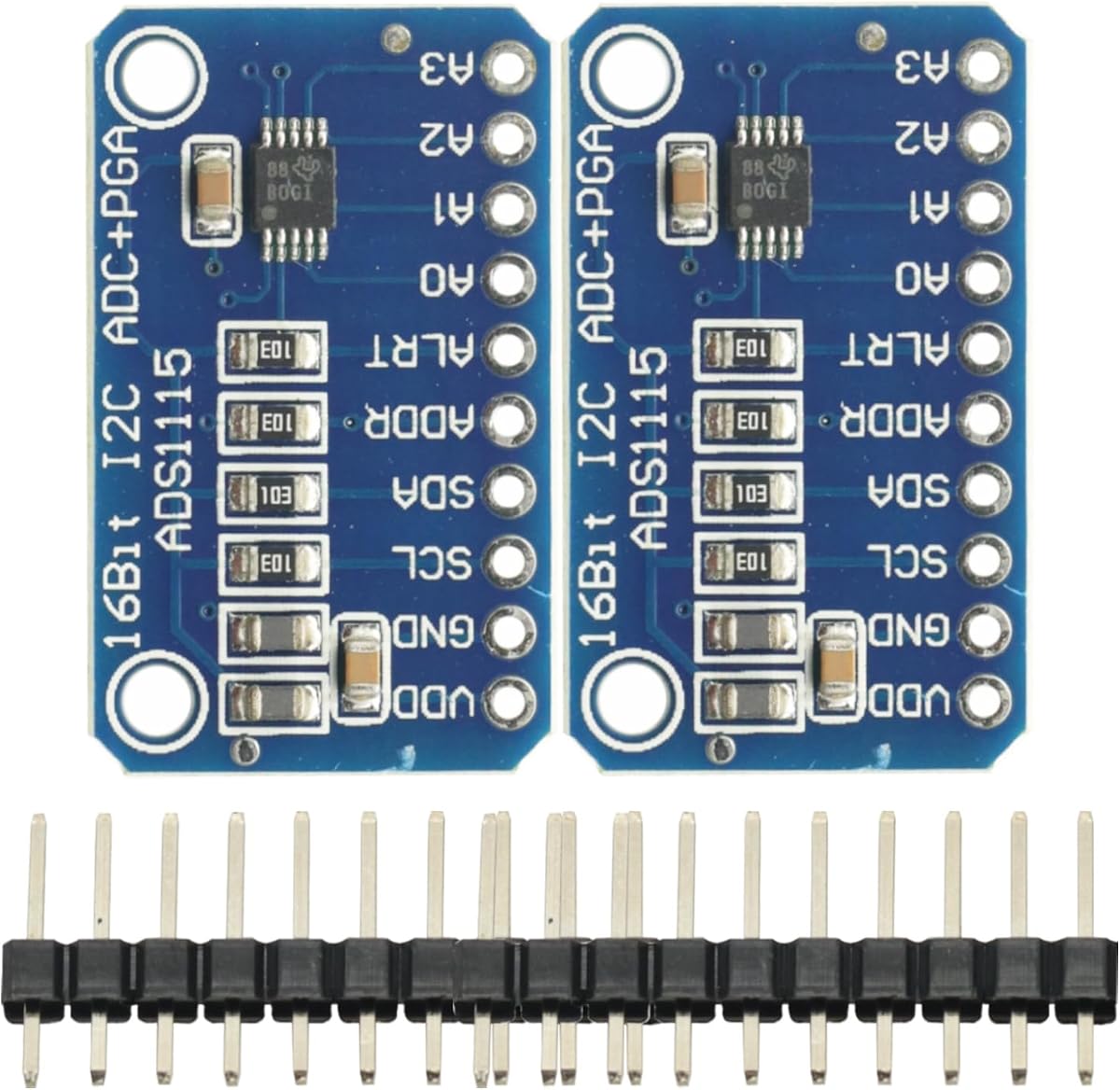
2Pcs ADS1115 16 Bit I2C Module Precision ADC
5.0Editor score
Pack of two units
Cost-effective solution
Four input channels
Easy I2C wiring
This guide compares the top 10 Arduino ADC boards for precision analog-to-digital conversion, featuring 16-bit and 24-bit options for various maker projects.
Selecting the right Arduino ADC board is crucial for accurate sensor readings in electronics projects. High precision conversion ensures reliable data from temperature, voltage, or pressure sensors. The best modules offer wide voltage ranges and easy integration with microcontrollers like Arduino and Raspberry Pi.
We evaluated ten top-rated ADC modules based on resolution, channel count, interface type, and user feedback. Each product was assessed for build quality, programmable gain features, and compatibility with common development environments. Our goal is to help you choose the ideal board for your specific data acquisition needs.
Every pick highlights unique strengths such as multi-channel support, high sampling rates, or cost-effective packaging. These reviews provide detailed insights into performance and ease of use. Note that pricing and availability may fluctuate, so verify current stock before purchasing your preferred model.
5.0Editor score

4.7Editor score

4.4Editor score
The following table offers a side-by-side comparison of all ten selected Arduino ADC boards to help you quickly identify the best fit for your project requirements.




The Teyleten Robot ADS1115 3 Pack stands out as a top choice for precision data acquisition tasks. With a 4.7 rating, this module delivers reliable 16-bit conversion across four analog channels. It is ideal for makers needing multiple boards for multi-node sensor networks.
We may earn a commission when you buy through this link, at no additional cost to you.
Key strengths include the built-in programmable gain amplifier which allows for measuring small voltage changes down to millivolt levels. The I2C interface simplifies wiring by requiring only two data lines plus power and ground. Additionally, the supply range from 2.0V to 5.5V ensures compatibility with various microcontroller logic levels.
While the maximum data rate of 860 samples per second is lower than some high-speed options, it is sufficient for most sensor applications like temperature or strain gauges. The auto shut down mode helps reduce power consumption in battery-operated projects. These trade-offs are acceptable given the module's robustness and ease of use.
This board is perfect for students and hobbyists working on IoT projects or environmental monitoring systems. Whether you need to track light levels or monitor battery voltage, this set provides the accuracy and flexibility required. We highly recommend this kit for its value and consistent performance.
The onboard PGA lets you scale input signals to maximize resolution without external components. This makes it easier to read low-level sensor outputs accurately.
With four available I2C addresses, you can chain multiple modules to increase channel count. This is useful for large sensor arrays on a single bus.
We may earn a commission when you buy through this link, at no additional cost to you.
The HiLetgo ADS1256 offers exceptional 24-bit resolution for users needing extreme precision in analog measurements. It provides eight single-ended inputs or four differential inputs for versatile signal capture. This module is rated 4.6 stars for its ability to handle detailed data acquisition tasks.
We may earn a commission when you buy through this link, at no additional cost to you.
Its high data rate of up to 30,000 samples per second makes it suitable for applications requiring fast sampling such as vibration analysis. The internal 2.5V reference voltage ensures stable readings without external components. Low nonlinearity further enhances measurement accuracy across the full input range.
Setting up the SPI interface can be more involved than I2C modules as it requires multiple control lines. However, this complexity is justified by the speed and resolution gains. The module is limited to 3V inputs so proper voltage conditioning is necessary for higher voltage signals.
Advanced makers working on scientific instruments or audio processing will appreciate the performance of this board. It bridges the gap between hobbyist tools and professional-grade data acquisition systems. Choose this if you prioritize resolution and speed over simple wiring.
Configurable as four differential pairs allows rejection of common-mode noise. This is vital for accurate readings in electrically noisy environments.
The ADR03 datum voltage source provides a reliable baseline for conversions. This reduces errors caused by power supply fluctuations.
We may earn a commission when you buy through this link, at no additional cost to you.
This 2-piece set of ADS1115 modules offers an affordable entry point for those needing multiple ADC boards. With a perfect 5.0 rating, users praise its reliability and ease of setup. It is particularly appealing for classrooms or group projects where budget constraints exist.
We may earn a commission when you buy through this link, at no additional cost to you.
Each module supports up to four input channels and features programmable gain to adjust sensitivity. The ability to set different I2C addresses allows multiple boards on the same bus without conflict. Input voltage ranges from 2.0V to 5.5V ensuring broad compatibility with standard logic levels.
While the packaging is minimal compared to premium kits, the performance remains consistent with individual high-end units. The small size fits neatly on breadboards or custom PCBs for compact designs. Some users may find the headers pre-soldered on some batches while others need manual soldering.
Buy this if you are building a sensor array or need spares for a large deployment. It delivers the essential features of the ADS1115 chip without unnecessary cost. For general purpose analog reading tasks, this bundle provides outstanding utility and reliability.
Use the 7 input ranges to fine-tune measurements for different sensor types. This adaptability makes it useful for diverse projects.
Buying a pack reduces the cost per unit significantly compared to single boards. This is helpful for prototyping with multiple devices.
We may earn a commission when you buy through this link, at no additional cost to you.
HiLetgo is a trusted name in maker components, and this 3-pack delivers consistent performance. With a 4.3 rating, it offers a practical solution for users needing multiple boards. The inclusion of comparator mode adds extra functionality for threshold monitoring.
We may earn a commission when you buy through this link, at no additional cost to you.
The module operates effectively within a wide voltage supply range from 2.0V to 5.5V. It supports programmable gain amplification to optimize signal levels for digitization. Auto shut down features help conserve energy when the board is idle or not actively sampling data.
While it lacks differential input capabilities compared to some other chips, it is robust for single-ended measurements. The 16-bit resolution provides enough granularity for most consumer electronics applications. Users appreciate the straightforward wiring and available library support for various microcontrollers.
This set is ideal for educators providing kits to multiple students or for prototyping with parallel test rigs. The value proposition is strong given the number of modules provided. We recommend it for projects where simplicity and cost efficiency are primary goals.
Comparator mode enables hardware interrupts when a value crosses a threshold. This reduces processor load by offloading decision making to the ADC.
Auto shut down and single-shot modes minimize power draw during sampling. This is essential for long-term battery-powered deployments.
We may earn a commission when you buy through this link, at no additional cost to you.
For large scale projects requiring many ADC channels this four-pack provides an economical bulk solution. It maintains the core benefits of the ADS1115 chip including high precision and programmable gain. Users rate it 4.1 stars noting good value for money despite occasional soldering variances.
We may earn a commission when you buy through this link, at no additional cost to you.
The onboard oscillator ensures consistent timing without external crystal components. This simplifies the circuit design by reducing the component count. The ability to sample up to four signals simultaneously aids in synchronizing sensor readings across multiple channels.
Some units may require manual header soldering which adds a small amount of assembly time. Quality control can vary with bulk kits so inspecting boards upon arrival is recommended. However, the electronic performance remains consistent with industry standards for 16-bit conversion.
This kit is best for makers managing large sensor arrays or industrial monitoring prototypes. It allows for distributed measurement nodes without a high per-unit cost. For those who can handle minor assembly tasks, this is a highly practical option.
Four differential input channels enable simultaneous acquisition of multiple signals. This is useful for correlated measurements in experiments.
Auto shut down modes optimize energy efficiency during idle periods. This supports deployment in remote or remote sensing scenarios.
We may earn a commission when you buy through this link, at no additional cost to you.
This pair of ADS1115 modules is praised for its flawless performance and user satisfaction. With a 5.0 rating, it offers a straightforward solution for adding analog capabilities to microcontrollers. It is particularly suitable for users needing just a couple of modules for distinct tasks.
We may earn a commission when you buy through this link, at no additional cost to you.
The programmable data rate allows users to balance speed and noise reduction based on specific needs. It supports seven input ranges from +/- 0.256V to +/- 6.144V providing significant flexibility. Input voltage tolerance covers the full range of 3.3V and 5V logic levels easily.
While it supports differential inputs, the primary mode is often used for single-ended sensors in basic projects. The I2C bus configuration ensures minimal pin usage on crowded boards. This simplicity is a major benefit for beginners or rapid prototyping efforts.
Choose this if you need two reliable modules for separate prototypes or a small distributed system. The ease of use and consistent performance make it a favorite among hobbyists. It is a smart buy for balanced performance and convenience.
Seven programmable ranges allow precise measurement across various signal levels. This adaptability ensures accurate readings regardless of sensor output.
Adjust data rates from 8 to 860 samples per second as needed. This helps in optimizing noise performance for steady signals.
We may earn a commission when you buy through this link, at no additional cost to you.
Lonely Binary emphasizes quality with ENIG gold plating that prevents oxidation and improves solderability. This 3-pack stands out for its premium build compared to standard modules. It is designed to work seamlessly with C++ ESP32 and Python environments out of the box.
We may earn a commission when you buy through this link, at no additional cost to you.
The modules are logic tolerant across 3.3V and 5V systems which simplifies interfacing with mixed voltage boards. Pre-soldered headers mean you can plug them directly into a breadboard without additional assembly. This is a significant time saver for classroom labs or busy prototyping sessions.
While the price is higher than budget options, the reliability and finish justify the investment for critical projects. The open-source friendly nature ensures robust community support for documentation and libraries. It reduces the risk of connection issues over time due to corrosion.
This is the ideal choice for professionals or educators who demand durability and ease of use. If you need components that will withstand repeated use or harsh environments, this set is worth the cost. We recommend it for quality-conscious makers.
The gold plating ensures long term reliability even in humid or industrial settings. This enhances the longevity of your sensor node.
Support for multiple languages ensures ease of integration for all skill levels. You can find libraries for both hardware abstraction and raw register access.
We may earn a commission when you buy through this link, at no additional cost to you.
The AD7606 module provides synchronous sampling across eight channels which is rare in this price range. It handles sampling rates up to 200kHz making it suitable for high frequency signal analysis. Users find it powerful for specialized applications like power line monitoring or audio.
We may earn a commission when you buy through this link, at no additional cost to you.
Its ability to capture all channels at once prevents phase errors between inputs. The parallel data output mode allows for faster processing when connected to appropriate interfaces. Input voltage ranges from +/- 5V to +/- 10V allowing direct connection to higher voltage signals.
The complexity of the interface and required logic levels can be a barrier for standard Arduino setups. It demands careful voltage level management and specific microcontrollers with SPI capabilities. This is a reason for the lower user rating compared to simpler boards.
This board is best for specialized engineering projects where timing and speed are critical. If you are working on multi-phase power systems or vibration testing, its features are unmatched. Advanced users will appreciate its robustness despite the higher setup hurdle.
Simultaneous sampling ensures all signals are recorded at the exact same instant. This eliminates phase lag issues in multi-channel data.
Supports bipolar inputs directly without external conditioning circuits. This saves space and cost in high-voltage applications.
We may earn a commission when you buy through this link, at no additional cost to you.
This four-pack delivers consistent performance with a 4.6 rating among users. It is designed to handle a variety of sensor types including pressure and light sensors reliably. The focus on low voltage sensor compatibility ensures accurate readings from delicate components.
We may earn a commission when you buy through this link, at no additional cost to you.
Integration is straightforward due to standard I2C pins that match most development boards. The internal gain amplifier helps boost weak signals to improve signal to noise ratio. Users appreciate the stability of readings over time without significant drift.
Documentation can be minimal which might slow down initial setup for beginners. Basic headers may require soldering if not pre-installed on your specific unit. Despite this, the modules perform well once connected and configured correctly.
Buy this for large IoT deployments where you need multiple data points across a room or building. It is cost effective for expanding the capabilities of a single controller. For general data acquisition, this set provides solid functionality.
Designed to work with a wide range of low voltage transducers. This makes it versatile for environmental and industrial sensors.
Built-in gain reduces noise from long wires or weak transducers. This helps in maintaining accuracy in real world conditions.
We may earn a commission when you buy through this link, at no additional cost to you.
This HiLetgo module offers a cost effective entry point into precision ADC usage. It shares key features with other popular boards including comparator mode and auto shut down. Users find it reliable for basic tasks like voltage monitoring and simple sensor logging.
We may earn a commission when you buy through this link, at no additional cost to you.
The 16-bit precision ensures adequate resolution for most general purpose applications. Programming gain settings allow for flexibility in measuring different voltage ranges. The design is straightforward with minimal overhead making it easy to integrate into existing projects.
While it lacks advanced features like high speed sampling or differential input, it fulfills basic needs well. It is an excellent spare or backup option for your electronics toolkit. The price point makes it accessible for students and budget focused hobbyists.
Choose this if you need a straightforward ADC without extra complexity. It provides the essential functionality needed for learning and prototyping. We recommend it for entry-level projects where simplicity is preferred over advanced specs.
Fewer configuration options mean less chance of setup errors. This is ideal for beginners learning ADC basics.
Built-in auto shut down helps extend battery life in remote sensors. This saves power when the module is inactive.
We may earn a commission when you buy through this link, at no additional cost to you.
Selecting the right ADC board depends on your project's specific requirements. This section covers key factors to consider before making a purchase.
Resolution refers to the number of bits the ADC uses to represent an analog signal. Higher resolution like 24-bit allows for finer measurement of small voltage changes. For general sensor tasks 16-bit is usually sufficient. Consider how much detail you need in your readings.
Look for modules with stable reference voltages to maintain accuracy over time. Drift can ruin precise measurements so quality components matter.
Count how many sensors you need to connect simultaneously. Some modules offer four channels while others offer up to eight. Differential inputs can help reject noise in noisy environments.
Ensure the board supports the input types your sensors use. Single-ended is common but differential is better for industrial settings.
Most boards use I2C which requires only two pins plus power. This simplifies wiring and allows multiple devices on the same bus. SPI is faster but uses more pins.
Check your microcontroller's available pins before buying. I2C is generally preferred for simplicity and wiring constraints.
Sampling rate determines how quickly you can read data. Most hobby modules max out at 860 samples per second. High speed options exist for audio or vibration analysis.
Choose a speed that matches your application's needs. Slow sensors do not require high speed modules.
Ensure the module's supply voltage matches your microcontroller. Most boards work with 3.3V and 5V systems. Input ranges should cover your sensor outputs.
Mismatched voltages can damage components. Use level shifters if necessary but check specs first.
Programmable gain amplifiers allow you to scale small signals. This improves sensitivity for low voltage sensors. Look for boards with multiple gain settings.
A good PGA helps avoid external amplifier circuits. This saves space and reduces complexity in your design.
Check if headers are pre-soldered for easy use. Quality PCB plating ensures better longevity. Small boards may be harder to solder manually.
For classrooms, pre-soldered modules save time. For custom boards, bare PCBs might be better.
Good libraries make coding easier. Look for open-source libraries that match your IDE. Some brands provide specific drivers.
Community support helps resolve issues quickly. Check forums for your chosen module before buying.
Connect the VCC and GND pins to your microcontroller's power rails. Ensure voltage levels match before powering up. Connect SDA and SCL pins to the respective I2C pins on your board.
Install the appropriate library for your ADC module in your IDE. Verify the I2C address using a scanner tool. Use example sketches to test readings before integrating into your project.
Avoid exceeding input voltage limits to prevent damage. Keep connections secure to avoid noise. Regularly check wiring for wear and tear in active projects.
Single-ended inputs measure voltage relative to ground. Differential inputs measure the difference between two lines to reject noise. Differential is better for long wires.
Yes, using different I2C addresses. Most boards allow up to four on one bus. This lets you add up to sixteen channels easily.
Divide the raw ADC value by the max count. Multiply by your voltage range. Adjust based on the gain setting used.
Most boards support 3.3V logic levels. However some have 5V tolerance. Check the datasheet before connecting.
It boosts small signals before conversion. This improves resolution for low voltage sensors. It allows a wide input range flexibility.
SPI offers higher data rates but uses more pins. I2C is slower but simpler. Choose based on your speed needs.
Noise can come from power sources or wiring. Use capacitors near the module. Ensure stable ground connections.
Yes, all models support Raspberry Pi GPIO. Libraries exist for Python. Just match the voltage levels carefully.
We highlighted the Teyleten ADS1115 and Lonely Binary Gold Edition as top choices for precision and build. These models deliver reliable performance for diverse maker projects.
Prioritize resolution and channel count based on your sensors. If speed matters choose SPI options. Otherwise I2C offers simplicity.
Prices and availability may change so check listings before buying. We hope this guide helps you find the perfect ADC board.