
Omada AX3000 Wireless Access Point
4.5Editor score
Free Cloud Management
Wi-Fi 6 Speeds
5 Year Warranty
This guide compares the top 10 commercial wireless routers for businesses, covering security, speed, and management features to help you choose the right
Selecting the right commercial wireless router is critical for maintaining a reliable and secure business network. High-performance models ensure seamless connectivity for employees, customers, and IoT devices across various environments.
We evaluated ten leading models based on speed, security protocols, management capabilities, and scalability. Our analysis focuses on features that matter most to business operations, including guest portals and VPN support.
Each pick highlights specific strengths and ideal use cases for different business sizes. Please note that product availability and pricing can change frequently, so verify details before making a final purchase decision.
4.5Editor score
4.2Editor score

4.6Editor score
The following table provides a side-by-side overview of key specifications for each router. This comparison helps you quickly identify which model aligns best with your specific network requirements and business goals.




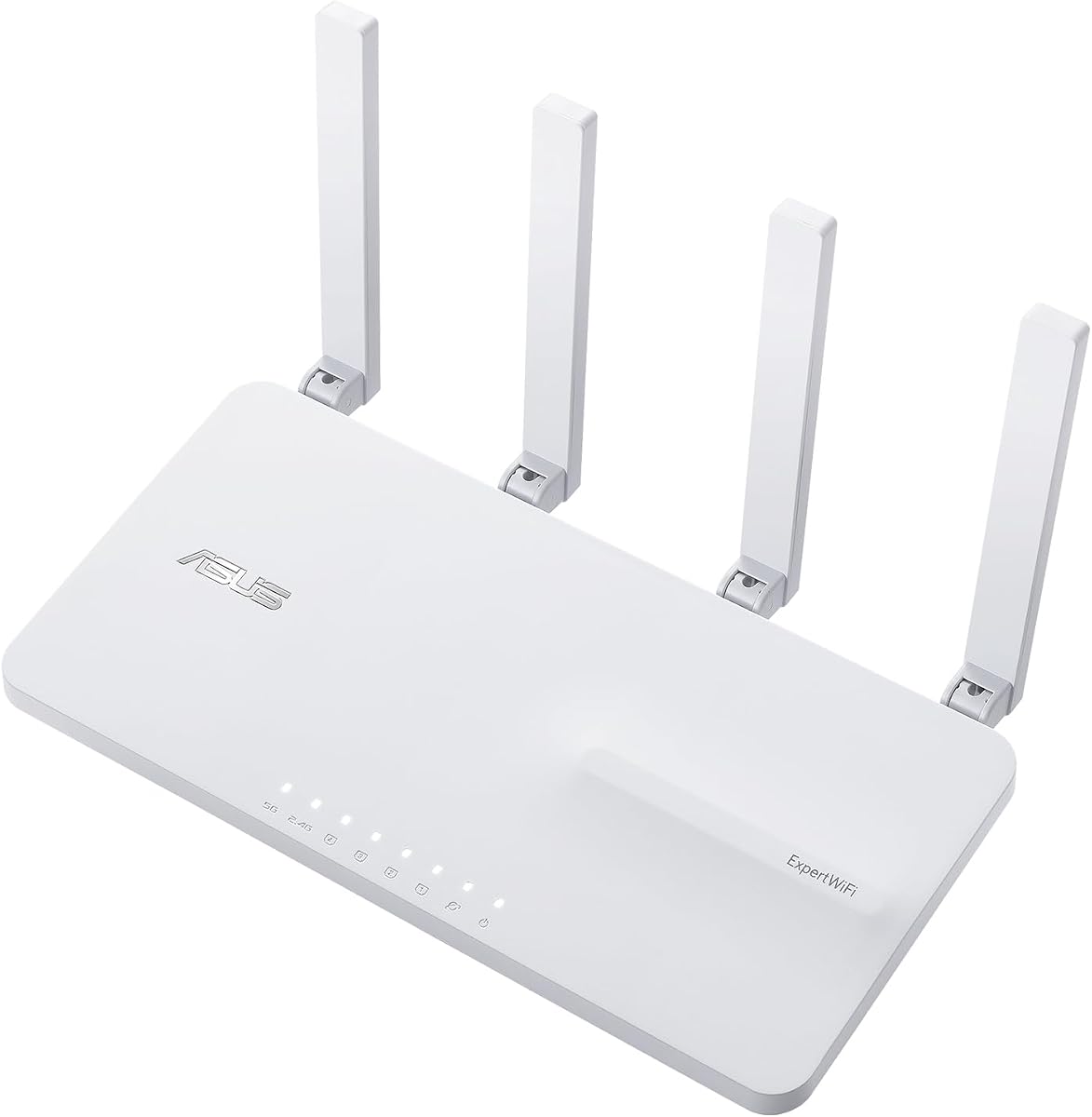
The ASUS ExpertWiFi EBR63 AX3000 stands out as a reliable choice for small to medium businesses seeking robust connectivity. With a strong rating from users, this router offers tailored features like custom guest portals and secure device separation.
We may earn a commission when you buy through this link, at no additional cost to you.
Its standout qualities include the ability to create up to five separate SSIDs, allowing you to prioritize traffic for different business scenarios. The included free subscription to ASUS AiProtection Pro adds a critical layer of security against online threats.
While it does not support the latest Wi-Fi 7 standard, the AX3000 speeds are sufficient for most current business needs. The backup WAN feature via USB ensures connectivity remains stable even if the primary internet line fails.
Business owners who need easy remote management and scalable options will find this router ideal. It is a solid investment for those prioritizing security and ease of use over raw speed capabilities.
Customize the SSID, portal type, brand name, and templates to fit your business style for a professional guest experience.
The ExpertWiFi AIMesh capability allows you to expand your network seamlessly as your business grows without complex wiring.
We may earn a commission when you buy through this link, at no additional cost to you.
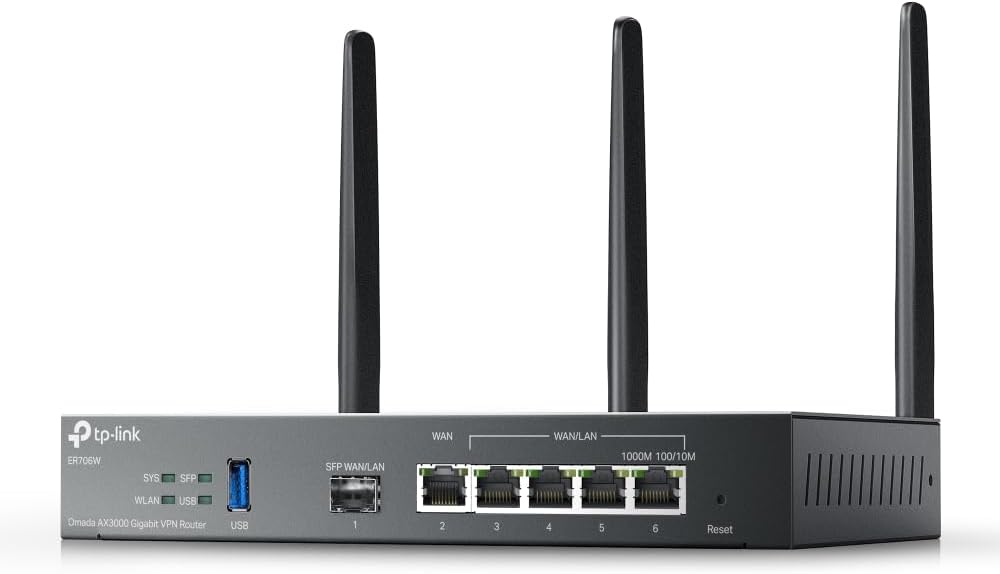
The Omada ER706W is a powerful VPN router designed for businesses that require secure remote access and flexible connectivity. It supports a wide range of high-security protocols including SSL, IPSec, and WireGuard.
We may earn a commission when you buy through this link, at no additional cost to you.
Key strengths include its load balancing capabilities, which raise the utilization rate of multi-line broadband connections. This ensures that your internet connection is used efficiently and remains stable even during peak usage times.
A potential trade-off is that this device functions primarily as a router and does not include built-in wireless capabilities. You will need to pair it with compatible Omada access points to extend your WiFi network effectively.
IT professionals and businesses needing robust VPN infrastructure will appreciate the flexibility of this router. It is an excellent choice for securing data transmission between remote offices and the main corporate network.
Supports SSL, IPSec, GRE, WireGuard, and other protocols to ensure secure remote access for your team.
Mesh with Omada access points to extend WiFi coverage without extra cabling or additional switches.
We may earn a commission when you buy through this link, at no additional cost to you.
The Ruckus Wireless R750 is engineered to deliver exceptional performance in ultra-dense environments where many devices connect simultaneously. It is a top choice for conference centers or large office spaces.
We may earn a commission when you buy through this link, at no additional cost to you.
Its standout quality is its ability to maintain high throughput even when dozens of devices are connected. The Ruckus BeamFlex+ technology adapts signal patterns to ensure stability and speed.
While it is more expensive than some alternatives, the reliability and performance justify the cost for mission-critical deployments. It is an access point rather than a standalone router, so it integrates into a larger network system.
Businesses with crowded networks will find this access point essential for maintaining seamless connectivity. It is ideal for scenarios where user experience and network capacity are the highest priorities.
Patented smart antenna technology maximizes signal coverage, throughput, and network capacity for any client.
Specifically designed to handle high device counts in spaces like stadiums, arenas, or large conference halls.
We may earn a commission when you buy through this link, at no additional cost to you.
The Ruckus R670 Indoor brings next-generation Wi-Fi 7 capabilities to mainstream business deployments. It is designed to provide exceptional end-user experience in environments like guest rooms and meeting rooms.
We may earn a commission when you buy through this link, at no additional cost to you.
Key strengths include its converged access capabilities, allowing unification of Wi-Fi and non-Wi-Fi wireless technologies like BLE and Zigbee. The built-in 5 GbE port ensures your network infrastructure does not become a bottleneck.
One trade-off is the price point, which is higher than standard access points. However, the future-proofing and enhanced data rates justify the investment for businesses preparing for modern connectivity demands.
Organizations looking to unify their networks and support future wireless standards should consider this model. It offers a seamless experience for users while providing robust management options for IT teams.
Provides exceptional data rates and reduced latency for demanding applications and future devices.
Unify Wi-Fi with IoT technologies using built-in BLE or Zigbee support for a single network.
We may earn a commission when you buy through this link, at no additional cost to you.
The NETGEAR Orbi 970 Series represents the pinnacle of home and office mesh systems with its WiFi 7 technology. It offers blazing-fast speeds and reliable connectivity for environments with hundreds of devices.
We may earn a commission when you buy through this link, at no additional cost to you.
Its standout quality is the dedicated quad-band backhaul that ensures traffic between satellites does not slow down client devices. Combined with 10 Gig ports, it handles the most demanding internet plans without bottlenecking.
The high price tag is a significant trade-off for smaller businesses, but for large offices or properties requiring extensive coverage, it is unmatched. You must also purchase a separate modem to use this system.
Businesses needing whole-home or whole-office coverage without dead zones should prioritize this system. It simplifies network management while delivering enterprise-level performance for critical applications and video conferencing.
Blanket up to 10,000 sq ft with fast WiFi from front door to backyard.
Ultra-fast wired connections for gaming PCs, NAS drives, and home offices for reliability.
We may earn a commission when you buy through this link, at no additional cost to you.
The Omada AX3000 Wireless Access Point offers incredible value for businesses seeking reliable connectivity without breaking the budget. It delivers Wi-Fi 6 speeds up to 2976 Mbps efficiently.
We may earn a commission when you buy through this link, at no additional cost to you.
Its key strength is the free cloud management option, which removes the need for expensive hardware controllers. You can manage the network entirely through the cloud, reducing operational costs significantly.
While it lacks the advanced features of premium enterprise gear, it covers all the basics well. The 5-year warranty provides peace of mind and ensures long-term reliability for your business investment.
Small businesses, cafes, and offices needing simple yet robust coverage will find this access point ideal. It is a cost-effective way to expand your network while maintaining professional-grade performance.
Launch the Omada app to manage the network in the cloud without additional hardware or software fees.
Compact and elegant appearance blends into modern offices while supporting multiple power options.
We may earn a commission when you buy through this link, at no additional cost to you.
The Ubiquiti U6+ is a sleek and powerful access point known for its high-speed data transfer capabilities. It ensures trouble-free connectivity through its robust IEEE 802.11 standard support.
We may earn a commission when you buy through this link, at no additional cost to you.
Its standout quality is the combination of efficient communication and elegant design. The wall mountable form factor allows for flexible placement, ensuring maximum coverage without cluttering office space.
A trade-off is that this access point requires a UniFi Controller for optimal setup and management. Businesses need to invest in the necessary infrastructure to unlock its full potential.
Design-conscious businesses needing reliable indoor coverage should consider this model. It integrates beautifully into modern environments while delivering solid performance for daily business operations.
Comfortable installation that ensures maximum comfort and fatigue-free usage for staff and guests.
Receive data and power up to 25.5W through a single cable for flexible placement.
We may earn a commission when you buy through this link, at no additional cost to you.
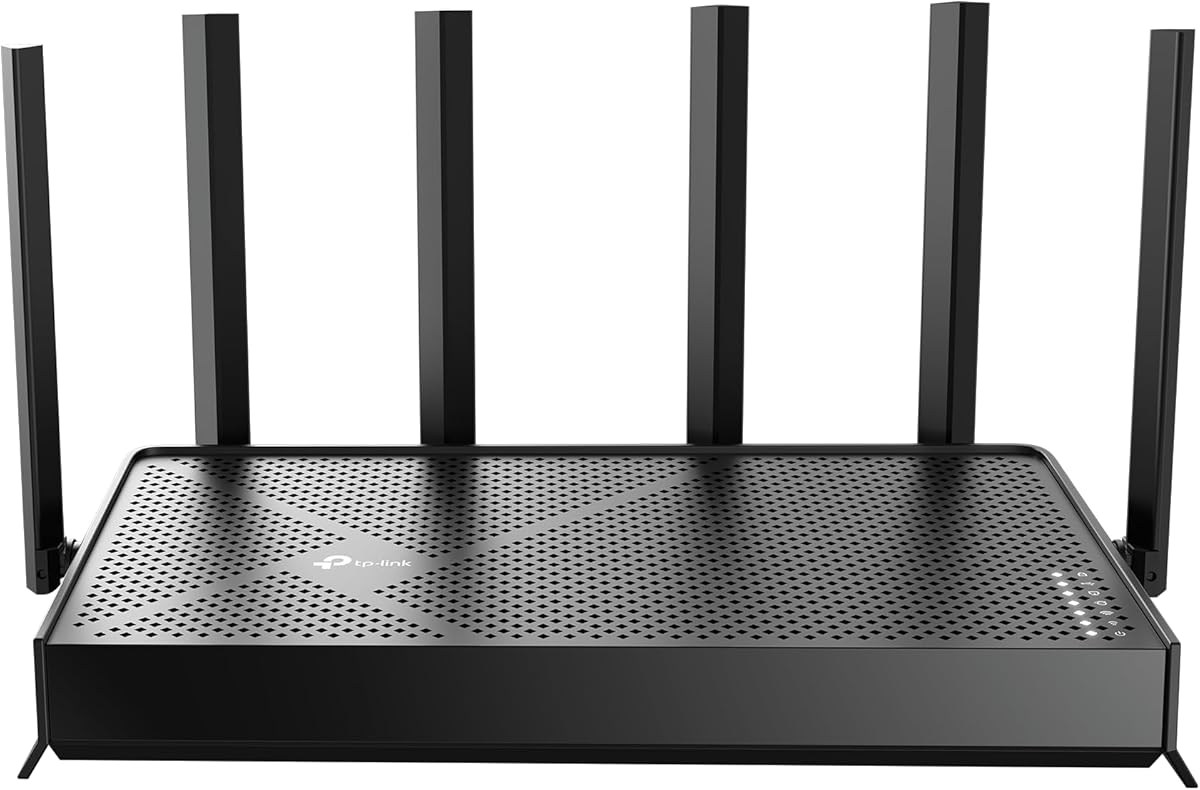
The TP-Link BE6500 is designed for businesses looking to future-proof their network with the latest Wi-Fi 7 technology. It features Multi-Link Operation to enhance throughput and reduce latency.
We may earn a commission when you buy through this link, at no additional cost to you.
Key strengths include its 2.5 Gbps ports, which support multi-gig internet plans efficiently. The device is built with security as a core requirement, aligning with the Secure-by-Design pledge.
One limitation is its incompatibility with TP-Link Deco mesh systems. If you already use Deco, this router may not mesh seamlessly without additional configuration or hardware changes.
Businesses seeking high-performance routers for demanding applications like AR/VR will benefit from this model. It balances speed and security while supporting up to 90 devices simultaneously.
Simultaneously transfers data across frequency bands for enhanced throughput and reliability.
High-speed data transmissions via WAN/LAN ports to integrate with multi-gig modems.
We may earn a commission when you buy through this link, at no additional cost to you.
The NETGEAR Nighthawk WiFi 7 router offers tri-band performance to keep up with a busy connected home or office. It delivers up to 9.3 Gbps for a fast experience across multiple users.
We may earn a commission when you buy through this link, at no additional cost to you.
Its standout quality is the dedicated third band, which gives your fastest devices their own lane. This prevents slower devices from impacting the performance of high-bandwidth applications.
A trade-off is the coverage area, which is optimized for single-story homes or offices around 2500 sq ft. Larger spaces may require a mesh system to avoid signal loss.
Businesses or home offices needing high speed without mesh complexity will find this router suitable. It simplifies network management while providing advanced security features out of the box.
A third high-speed band for demanding devices keeps your network fast as it grows.
Plug your modem into the 2.5 Gig WAN port to unlock multi-gig internet plans.
We may earn a commission when you buy through this link, at no additional cost to you.
The ASUS RT-BE88U is a powerhouse router designed to unleash demanding Wi-Fi 7 and 10G network applications. It features a quad-core 2.6GHz CPU to handle heavy network loads efficiently.
We may earn a commission when you buy through this link, at no additional cost to you.
Its standout quality is the dual 10G ports, which maximize wired network capacity for file transfers and data streaming. This ensures your wired devices can utilize the full speed of your internet connection.
The high price is a trade-off, but it justifies the premium features for performance-oriented businesses. It supports AiMesh for scalability, allowing you to add nodes for more coverage later.
Businesses with heavy data demands and advanced security needs should consider this router. It provides robust connectivity and comprehensive VPN support for secure site-to-site communication.
Bolster your wired network capacity up to 34G with 10G SFP+ and WAN/LAN ports.
Stay secure with AiProtection Pro powered by Trend Micro for comprehensive site-to-site VPN support.
We may earn a commission when you buy through this link, at no additional cost to you.
Choosing the right commercial wireless router involves evaluating several technical factors to ensure your network meets business demands. This guide outlines the key aspects you should consider before making a purchase.
The WiFi standard determines the maximum speed and efficiency of your network. Wi-Fi 6 and Wi-Fi 7 routers offer faster speeds and better handling of multiple devices. Prioritize models with high aggregate bandwidth if you expect many simultaneous users.
Always check the rated throughput to ensure it matches your internet plan and device count.
Commercial networks require robust security to protect sensitive business data. Look for routers with built-in firewalls, intrusion prevention, and support for VPNs. Free security subscriptions like AiProtection Pro add value by blocking malware and phishing attacks.
Ensure the router supports WPA3 encryption to secure connections against modern threats.
Ease of management is critical for maintaining network stability without dedicated IT staff. Cloud management options allow you to monitor settings and updates remotely. Some routers offer dedicated apps for simple setup and ongoing control.
Verify whether the system supports mesh expansion for future growth.
The number and type of Ethernet ports impact how you connect devices and modems. Gigabit ports are standard, but multi-gigabit ports are needed for high-speed internet plans. USB ports can provide backup connectivity or storage expansion.
Count your wired devices to ensure you have enough ports or plan for a switch.
Businesses often need separate networks for customers and employees. Routers with custom guest portals allow you to manage access and branding professionally. This segregation ensures visitor traffic does not impact your internal network speed.
Look for options that let you customize login pages or set data limits.
Your network should grow with your business. Mesh capabilities allow you to add access points or satellites to cover more area. Ensure the system supports seamless roaming so devices stay connected as users move around.
Check compatibility with existing or future network equipment.
Reliable support is essential for minimizing downtime. Check the warranty length and the availability of technical support. A longer warranty often indicates higher confidence in product durability and reliability.
Select models from vendors with a strong track record of timely updates and assistance.
Consider how the router gets powered and installed. PoE support is useful for access points where power outlets are limited. Physical design should fit your office environment without creating clutter.
Ensure you have the necessary cabling and power sources ready before setup.
Start by connecting the router to your modem via Ethernet cable. Use the manufacturer's app to configure basic settings like admin passwords and SSID names.
Regularly update the firmware to patch security vulnerabilities and improve performance. Most routers offer automatic updates or reminders to install new versions.
Place the router in a central, elevated location to maximize signal coverage. Avoid enclosing it in cabinets or placing it near metal objects that block signals.
WiFi 7 routers offer significantly higher throughput, lower latency, and better multi-device handling than WiFi 6. They introduce new features like Multi-Link Operation to maximize efficiency. This makes them ideal for future-proofing high-demand business environments.
Most of these routers function as gateways or access points and require a separate modem to connect to your internet service provider. Some models have a WAN port that directly accepts the modem connection. Check the product specs to confirm.
Many routers support mesh expansion or can be paired with compatible access points. This allows you to add nodes to cover larger areas without rewiring. Ensure the new devices are compatible with your existing system.
Guest networks isolate customer traffic from your internal business devices. This prevents unauthorized access to sensitive data while providing internet access to visitors. Some routers let you customize the login page for branding purposes.
Most models include mobile apps with guided setup wizards that simplify configuration. You can typically set up SSIDs and passwords within minutes. However, advanced features like VPNs may require more technical knowledge.
Some routers support backup WAN connections via USB or secondary ports. You can connect a mobile hotspot to maintain connectivity during outages. This ensures critical business operations remain online during internet interruptions.
Most modern routers support WPA3 as the latest security standard. It provides stronger encryption and protects against common password attacks. Ensure your devices also support WPA3 to take full advantage of this feature.
High-end routers can support hundreds of devices simultaneously without slowing down. Lower-end models typically handle around 50 to 100 devices. Choose based on your expected number of employees and IoT equipment.
We reviewed ten top commercial wireless routers ranging from budget-friendly options to premium Wi-Fi 7 models. Each offers distinct advantages depending on your business size and security needs.
Prioritize security features, management tools, and scalability when making your decision. High performance matters, but ease of use ensures long-term reliability for your network.
Remember to check current product availability and prices before purchasing. Technology evolves quickly, and verifying the latest specs ensures you get the best value for your investment.