This guide compares ten top DAC for Raspberry Pi models for audio quality, compatibility, and value to help you choose the best digital converter for your
As an Amazon Associate we earn from qualifying purchases. We may earn a commission when you buy through links on this page, at no additional cost to you. Read our affiliate disclosure.As an Amazon Associate we earn from qualifying purchases.Purchases through our links may earn us a commission, at no extra cost to you. Read our affiliate disclosure.
Transform your Raspberry Pi into a high-fidelity audio streamer with a dedicated digital to analog converter. These modules replace the built-in audio jack with superior circuitry for clearer sound and deeper bass across all music genres.
We evaluated ten leading options based on chip quality, supported sample rates, and software compatibility with popular players like Volumio and Moode. Each model offers unique strengths for budgets ranging from entry-level DIY kits to professional grade desktop units.
Every pick below highlights specific features like dual oscillators or balanced outputs to match your audio needs. Prices fluctuate frequently so check current listings before purchasing to ensure you get the best deal available today.
Top 3 Picks for Best DAC for Raspberry Pi
Best Budget
HiLetgo PCM5102 I2S IIS Lossless Digital Audio DAC Decoder Module Stereo DAC Digital-to-Analog Converter Voice Module for Arduino Raspberry Pi
HiFi DAC Pro Hat with ES9038Q2M Chip for Raspberry Pi 5/4/3B+/3B/Zero – High-Resolution 384KHz/32bit & DSD512 Audio Card, DAC Converter for Volumio, Moode, Headphone & Balanced Output
This side-by-side table compares key specifications across all ten models including chip type, supported sample rates, output options, and compatibility notes to help you quickly identify the right fit for your project.
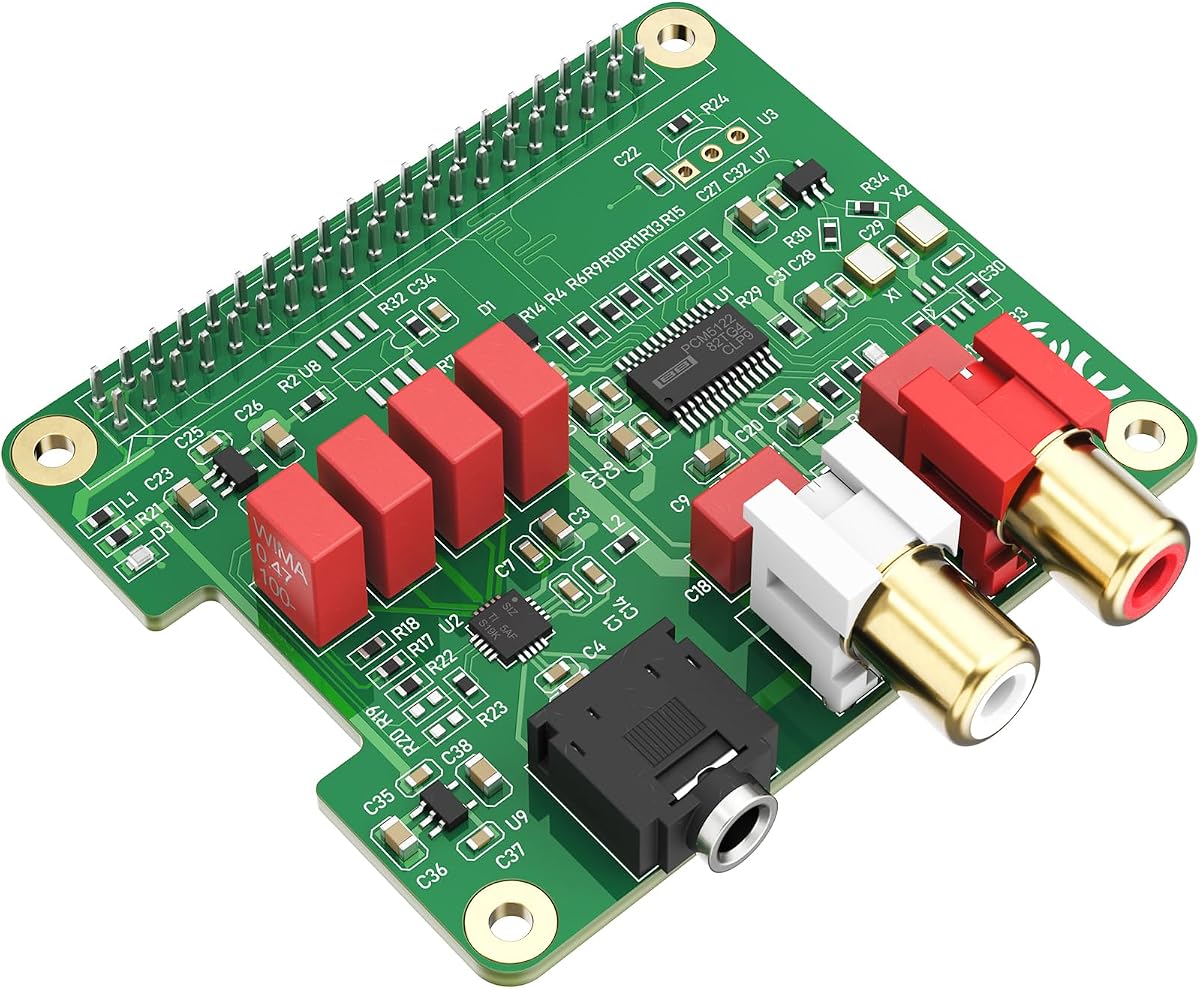
This expansion board earns our top pick by delivering studio-grade audio clarity through a carefully engineered PCM5122 DAC. Its dual ultra-low jitter oscillators and 112dB signal-to-noise ratio set a new benchmark for cost effective home audio setups.
Pros
Dual clocks eliminate jitter
Independent ground paths
Wide OS support
Gold-plated outputs
Reserves IR port
Cons
No balanced XLR
Plastic spacers only
We may earn a commission when you buy through this link, at no additional cost to you.
The reference-class design includes film capacitors and a master-clock mode that strips timing noise from the Raspberry Pi. Dual outputs provide gold-plated RCA line-level connections plus a dedicated TPA6133 headphone amp for driving high-impedance cans.
While it lacks balanced XLR connectors the independent grounding effectively eliminates crosstalk between channels. Plug-and-play EEPROM setup means you can stream high-res audio via Volumio or Moode within minutes of installation.
Buy this HAT if you need a reliable turnkey DAC that works with Pi 5 and older models alike. The developer-optimized design and open-source SDK ensure long-term software support for your custom projects.
Dual Oscillators Ensure Crystal Clear Sound
Two dedicated 45MHz and 49MHz oscillators provide precise sample rates that eliminate the timing jitter inherent in standard Pi clocks.
Independent Grounding Reduces Noise
Separate ground paths for RCA and headphone outputs prevent crosstalk so you get clean separation even with high-power amplifiers.
For builders with tight budgets this Mini Hat delivers the same PCM5122 core as higher end boards but trims non-essential features. It maintains excellent compatibility with zero W and Zero 2W boards without overhanging GPIO headers.
Pros
Lowest price point
Fits Pi Zero 2W
Same DAC as top pick
RCA and headphone out
OS compatibility
Cons
Single oscillator clock
No IR port reserved
We may earn a commission when you buy through this link, at no additional cost to you.
The TPA6133 headphone amplifier drives 2.1Vrms outputs ensuring powerful clean sound even for sensitive headphones. Extensive software support includes Volumio Moode OSMC and standard Linux distros out of the box.
While it uses a single oscillator instead of dual clocks audiophiles report minimal audible difference in most listening environments. The unbeatable value proposition makes it ideal for first-time DAC builds or multi-room setups.
Choose this shield if you need a compact low-cost solution that still handles 384kHz high-res streams. Its plug-and-play EEPROM ensures you spend time enjoying music rather than debugging drivers.
Perfect Fit for Zero Models
The board layout is optimized for Pi Zero Zero W and Zero 2W so no cables or adapters are needed to stack this HAT.
Shared Core with Premium Picks
You get the same TI PCM5122 DAC and 112dB SNR performance as the top-rated HAT for a fraction of the price.
This Pro Hat uses the flagship ES9038Q2M converter to deliver 129dB dynamic range and true DSD512 playback. It is the ultimate choice for audiophiles seeking bit-perfect high-resolution sound without relying on USB conversion.
Pros
Flagship DAC chip
Balanced XLR out
DSD512 support
Dual oscillators
Three op-amps
Cons
Highest price point
Requires external power
We may earn a commission when you buy through this link, at no additional cost to you.
Three Texas Instruments op-amps drive a robust 2.1Vrms output through both stereo jacks and balanced XLR connectors. Independent dual oscillators ensure timing precision even when streaming from network attached storage over noisy environments.
The higher price reflects its advanced architecture but it supports standard music player systems with plug-and-play drivers. Configuration guides via their online Wiki simplify advanced tuning for DSP fans and multiroom audio users.
Invest in this HAT if you demand the highest possible fidelity and balanced connections for professional audio gear. Its future-proof DSD512 support ensures your Pi remains capable for years to come.
Balanced XLR Outputs
X+ and X- connectors deliver noise-cancelled signals ideal for connecting to high-end amplifiers or active studio monitors.
DSD512 Support
Native DSD playback up to 512x ensures compatibility with the most demanding high-resolution audio libraries.
The Digi One Hat excels at sending pristine digital signals to external DACs or receivers using S/PDIF. Industrial-grade isolators and automotive power isolators prevent ground loops and electrical noise from corrupting your audio data.
Pros
Pure digital output
Galvanic isolation
Low jitter crystal
192kHz sampling
Universal music support
Cons
No analog conversion
Requires external DAC
We may earn a commission when you buy through this link, at no additional cost to you.
Optical TOSLINK and electric RCA outputs provide bit-perfect streams up to 192kHz without modification. The I2S master mode and external crystal oscillators ensure accurate clocking across all frequency ranges for critical listening.
Since this board does not convert analog signals it is ideal for users who already own a high-end DAC. Support for OSMC Volumio and Moode ensures seamless integration with your existing music player software.
Choose this hat if you want to isolate your Raspberry Pi from noisy power environments. Its industrial-grade design and high compatibility rating make it a reliable choice for long-term server builds.
Galvanic Isolation
Digital isolators break ground loops between the Pi and external gear ensuring hum-free digital signal transmission.
Master Mode Clocking
Independent external oscillators maintain precise timing even if the Raspberry Pi system load fluctuates during streaming.
This module offers a simple DIY route to high-fidelity sound using the proven PCM5122 DAC. It provides clear LED status indicators so you can quickly verify power and decoding states without opening system logs.
Pros
Visible LED status
IR receiver ready
120dB SNR
Low price
B+ 2 3 compatible
Cons
No spacers included
Manual GPIO wiring
We may earn a commission when you buy through this link, at no additional cost to you.
Sampling up to 384kHz with 120dB dynamic range this board supports high-resolution playback via Volumio or XBMC. The infrared receiver interface at GPIO26 allows you to add remote control capability to your custom media center.
While it lacks pre-installed spacers or HAT headers the low cost makes it perfect for prototyping. Users must manually wire outputs but the straightforward design simplifies integration with existing enclosures.
Opt for this module if you enjoy custom hardware builds and need visible status feedback. Its compatibility with older Pi 2 and 3 models ensures you can repurpose existing hardware effectively.
LED Status Indicators
Green and red LEDs show decoding and power states so you can troubleshoot audio issues without a monitor.
Infrared Receiver Ready
GPIO26 is reserved for IR input allowing you to add remote control functionality directly to your DAC setup.
This Hat leverages an EEPROM chip for plug-and-play setup making it one of the easiest DACs to integrate. Its colored PCB design adds aesthetic appeal while maintaining exceptional 384kHz 32-bit sampling rates.
Pros
No driver install
Aesthetic PCB design
Pi 5 ready
Zero 2 support
High SNR
Cons
Basic output options
No digital out
We may earn a commission when you buy through this link, at no additional cost to you.
Stereo 3.5mm jack and RCA outputs deliver clean 112dB SNR sound that surpasses standard USB DACs. Universal compatibility spans Pi 5 Pi 4 Zero 2 and earlier models ensuring wide hardware support.
The absence of digital outputs limits flexibility but the analog path is sufficient for most home listening. Ready-to-use functionality means no extra drivers are required for standard Raspbian or Linux distributions.
Select this hat if you want a clean plug-and-play experience with visual style. Its balanced compatibility and high SNR make it a solid choice for general-purpose media centers.
EEPROM Plug-and-Play
Preloaded drivers eliminate manual installation steps so you can start streaming audio immediately after boot.
Visual PCB Design
Aesthetic colored PCB adds a unique look to your project without compromising the audio signal quality.
This plug-and-play board includes a ground loop isolator to eliminate unwanted hum and noise in noisy electrical environments. Its compact design fits the Argon ONE V3 case ensuring a clean integrated audio setup for Pi 5 users.
Pros
Integrated isolator
Perfect Pi 5 fit
Easy installation
High user ratings
Low noise floor
Cons
3.5mm only
ONE V3 case only
We may earn a commission when you buy through this link, at no additional cost to you.
Powered by the PCM5122 digital audio codec it delivers high quality audio through a dedicated 3.5mm port. The isolated design prevents electrical interference from corrupting the signal so you get clean output even with sensitive gear.
While it lacks external RCA jacks the 3.5mm output is sufficient for most headphones and amplified speakers. The included isolator ensures you avoid the classic buzzing issues common with Pi audio projects.
Buy this solution if you are building a Pi 5 media box and want minimal fuss. Its perfect compatibility with the ONE V3 case and high user satisfaction make it a reliable turnkey option.
Integrated Ground Loop Isolator
Built-in isolation blocks electrical hum from the power supply ensuring cleaner audio without external adapters.
Perfect Pi 5 Fit
Designed specifically for Argon ONE V3 enclosures to maintain a compact professional look for your media center.
This DAC features a dedicated 300 MHz DSP that allows real-time equalization and sample rate conversion. It handles up to 6144 instructions per sample enabling advanced room tuning or multi-source mixing without taxing the Pi CPU.
Pros
Onboard DSP
Room equalization
Standalone audio
Up/downsample
High instructions per sample
Cons
CaseIII requirement
Higher price
We may earn a commission when you buy through this link, at no additional cost to you.
The board can boot without the Raspberry Pi thanks to onboard EEPROM making it useful as a standalone DAC. Asynchronous sample rate conversion ensures bit-perfect playback even when mixing different digital sources.
However it requires the exclusive CaseIII enclosure which limits modularity. The specialized features justify the premium price for advanced users needing flexible audio processing capabilities.
Choose this board if you need room equalization or standalone functionality. Its powerful DSP ensures your audio meets precise acoustic requirements without sacrificing performance.
Onboard DSP Power
Dedicated DSP allows complex audio manipulation like equalization and up/downsizing directly on the board.
Standalone Boot Mode
The board can run independently without the Pi enabling use as a dedicated DAC for other media players.
This card focuses on delivering bit-perfect digital signals via coaxial and optical Toslink outputs. It supports 192kHz 24bit resolution ensuring high-fidelity audio data reaches your external receiver without modification.
Pros
Bit-perfect stream
192kHz 24bit
Coax and Optical
Stable output
Low jitter chip
Cons
No analog conversion
Pi 2 legacy only
We may earn a commission when you buy through this link, at no additional cost to you.
The dedicated S/PDIF interface chip provides low jitter and robust timing for stable playback. Since it does not perform analog conversion it is ideal for pairing with high-end receivers or DAC units.
Note that it targets Pi 2 and A+ models which may limit use with newer hardware. For those legacy systems however it offers a reliable way to upgrade audio performance without complex software tweaks.
Buy this board if you maintain an older Pi setup and need a digital-only output. Its proven reliability and high bit-depth support make it a trustworthy choice for retro builds.
Bit-Perfect Output
The audio stream remains unmodified ensuring your receiver gets the original data without digital noise.
Coax and Optical
Dual output options give you flexibility to connect to any receiver regardless of input preference.
This module offers the most affordable entry into high-quality audio with a PCM5102A DAC. It provides a soldered stereo jack for immediate use and handles lossless audio via the I2S interface without onboard analog noise.
Pros
Lowest price point
Good sound quality
Soldered stereo jack
Easy integration
Arduino compatible
Cons
Basic features
No HAT header
We may earn a commission when you buy through this link, at no additional cost to you.
Despite its low cost users report sound quality significantly better than the onboard Pi audio jack. The digital nature of the conversion ensures clean data transfer which is the primary factor for clarity.
While it lacks premium features like dual oscillators it is a reliable baseline for beginners. The board works with Arduino and Pi making it versatile for multi-platform projects.
Select this module if you are on a strict budget or need a secondary DAC for a small project. Its ease of use and low price make it an accessible starting point for DIY audio.
Ultra Low Cost
You get high-quality digital audio conversion for a fraction of the cost of complete HAT boards.
Soldered Stereo Jack
The headphone port is pre-soldered so you can plug in speakers immediately without needing additional components.
We may earn a commission when you buy through this link, at no additional cost to you.
Buying Guide – How to Choose the Best DAC for Raspberry Pi
Selecting the right DAC depends on your hardware model desired sound quality and whether you need analog or digital outputs.
DAC Chip Quality
The core chip determines dynamic range and resolution. Look for TI PCM5122 or ESS ES9038Q2M chips which deliver 112dB or higher SNR for clear sound.
Prioritize chips that support at least 384kHz 32bit to ensure future-proof high-resolution audio support.
Clocking System
Dual oscillators reduce jitter significantly compared to relying on the Pi internal clock. This is crucial for high-resolution playback.
Choose models with external oscillators to eliminate timing errors that cause audible distortion in quiet tracks.
Output Options
Decide if you need RCA line outputs or 3.5mm headphone jacks. Premium boards offer balanced XLR outputs for professional audio.
Ensure the board matches your amplifier inputs to avoid needing extra adapters that add noise to the signal chain.
Hardware Compatibility
Check if the HAT fits your specific Pi model. Zero boards require compact designs while Pi 5 needs proper power regulation.
Confirm the board uses GPIO headers or spacers correctly to prevent short circuits during installation.
Software Support
EEPROM chips enable plug-and-play without driver installation. Ensure compatibility with Volumio Moode or LibreELEC.
Open-source SDK support helps if you plan to build custom software integrations for your media center.
Grounding and Isolation
Galvanic isolation prevents ground loops that cause humming. This is critical if your Pi shares power with other devices.
Models with independent ground paths for outputs minimize crosstalk between left and right audio channels.
Headphone Amplification
Dedicated headphone amps with higher wattage drive high-impedance cans better. Look for TPA6133 or similar op-amps.
Ensure the amp supports the impedance of your headphones to avoid weak or distorted audio output.
Future-Proofing
Support for DSD formats ensures compatibility with high-resolution files from streaming services. Check sample rate limits before buying.
Consider boards that support newer Pi models like Pi 5 to extend the life of your audio setup for years.
How to Use and Care for Your DAC for Raspberry Pi
Install the HAT by aligning GPIO pins carefully before powering up the system. Use spacers to prevent shorts between the board and Pi.
Connect output cables securely to RCA or 3.5mm jacks ensuring ground paths are clean. Avoid long cables to reduce noise interference.
Use supported software like Volumio or Moode to enable DAC output. Reboot after installation to let the system detect the new hardware.
Frequently Asked Questions
Do I need to install drivers for a DAC HAT on Raspberry Pi?
Most modern HATs use EEPROM to enable plug-and-play without manual driver installation. Simply insert the board and reboot the system to allow it to detect the audio output.
Which DAC chip is better PCM5122 or ES9038Q2M?
ES9038Q2M offers higher dynamic range and DSD support but PCM5122 provides excellent value. Choose ES9038Q2M for critical listening and PCM5122 for general use.
Can I use these DACs with Pi 5?
Most boards support Pi 5 but check power requirements. Some models require external power to avoid voltage drops when driving high-impedance headphones.
Why is my DAC humming or buzzing?
Ground loops often cause noise. Use a model with galvanic isolation or plug your audio equipment into a different outlet to reduce electrical interference.
Does the DAC affect system performance?
HATs use I2S hardware interfaces so they have minimal CPU load. Software like Moode optimizes playback to ensure smooth operation without lag.
What output should I use RCA or 3.5mm?
Use RCA for amplifiers and active speakers as they provide cleaner line-level signals. Use 3.5mm for headphones or portable speakers directly.
Can I use these DACs for voice assistants?
Yes but you need software like Home Assistant to route audio. Ensure your DAC supports simultaneous input and output if you need microphone integration.
Do I need a separate power supply for the DAC?
Most boards draw power from the Pi GPIO. However high-power headphones may need an external amplifier to prevent voltage drop issues.
Final Thoughts on Choosing the Best DAC for Raspberry Pi
The HiFi DAC HAT PCM5122 remains our top pick for balancing performance and value. It handles dual oscillators and wide software support flawlessly.
Prioritize chip quality and clocking systems over extra features to ensure long-term audio fidelity. Check hardware compatibility before installing to avoid return hassles.
Prices fluctuate so verify current listings before finalizing your purchase. Ensure the board meets your specific audio needs to maximize your investment.
Discover the top Dish RV Receivers for mobile entertainment. This guide compares receivers, antennas, and bundles to help you choose the perfect setup.
This guide compares the top automatic bookmarks for readers who want to track pages effortlessly without damaging books with traditional markers or clips.