
EUDAX Physics Science Lab
4.6Editor score
Basic circuit building
Storage box included
English instructions
This guide compares the top electricity learning kits for kids and students, highlighting features, project counts, and educational value to help you choose
Electricity learning kits provide hands-on experiences that bring abstract physics concepts to life. These educational tools allow students to build circuits, explore magnetism, and understand energy flow through practical experimentation. Choosing the right kit depends on age appropriateness and project variety.
We evaluated ten top-rated products based on component quality, instructional clarity, and project diversity. Each kit was reviewed for its ability to engage learners while maintaining safety standards. Our analysis focuses on value, educational depth, and user feedback from parents and educators.
Each pick showcases unique strengths ranging from basic circuit building to advanced electromagnetism projects. Note that prices and availability may change over time. Always verify current details before purchasing to ensure you get the best value for your educational needs.
4.6Editor score

4.7Editor score

4.5Editor score
The following table offers a side-by-side comparison of all ten products to help you quickly identify which kit meets your specific learning goals and budget requirements.



This kit stands out with over 120 projects designed to keep kids engaged for hours. Rated 4.7 stars, it combines safety with extensive educational content suitable for young learners.
We may earn a commission when you buy through this link, at no additional cost to you.
The included video instructions via QR code make setup intuitive. Kids can build light shows and sound systems while learning how circuits work in practice.
While the price is higher than basic sets, the variety justifies the cost. The lack of tool requirements ensures safety without sacrificing learning depth.
Ideal for curious kids who want to explore beyond simple circuits. Parents seeking a comprehensive STEM gift will find this kit highly rewarding.
With 120+ activities, this kit ensures long-term engagement and repeated learning opportunities for growing minds.
Features like keyboard modes and light shows make abstract electrical concepts tangible and fun for children.
We may earn a commission when you buy through this link, at no additional cost to you.
Designed for high school students, this kit offers advanced modules like Joule's law. It bridges classroom theory with hands-on practice effectively.
We may earn a commission when you buy through this link, at no additional cost to you.
The 55 items for electricity and 22 for magnetism provide a robust foundation. Manuals guide students through complex concepts with clarity.
Storage is organized in a double-layer box, keeping components secure during transport. This durability supports classroom and home use equally well.
Best for students ready to move beyond basic circuits. Those seeking depth in electromagnetism will appreciate the specialized tools included.
Includes sensitive ammeters and magnetic switches for real-world physics exploration beyond basic experiments.
The sturdy storage box ensures every item has a fixed place, making it easy to carry to study groups.
We may earn a commission when you buy through this link, at no additional cost to you.
This basic kit serves as an excellent entry point for students in 7th to 9th grade. It helps consolidate textbook knowledge through simple circuit assembly.
We may earn a commission when you buy through this link, at no additional cost to you.
The English manual simplifies setup for non-native speakers. A plastic storage box keeps all accessories organized and ready for future use.
While it lacks advanced magnetism tools, it fulfills core electricity learning needs effectively. The safety focus ensures peace of mind for parents.
Perfect for budget-conscious buyers introducing children to electronics. It builds a strong foundation for more complex kits later on.
English instructions make this kit globally accessible for diverse student populations needing clear guidance.
Designed specifically to be safe for young learners, focusing on essential concepts without unnecessary complexity.
We may earn a commission when you buy through this link, at no additional cost to you.
This kit balances 56 electricity and 21 magnetism items for comprehensive STEM learning. It targets high school students needing deeper physics insights.
We may earn a commission when you buy through this link, at no additional cost to you.
Students can build fruit batteries and electromagnets to understand fundamental laws. The manual guides them through every experiment with clarity.
While the storage bag is convenient, it may be less secure than a box. However, the repair tools included add extra value for longevity.
Ideal for students needing both electricity and magnetism modules. It offers a solid foundation for advanced physics coursework.
Combines both major fields in one package to provide a holistic understanding of energy and forces.
Includes repair tools to extend the kit's lifespan and ensure continued use throughout the academic year.
We may earn a commission when you buy through this link, at no additional cost to you.
With 50 pieces and 18 experiments, this kit encourages family participation in science. It is designed for children aged 8 and up.
We may earn a commission when you buy through this link, at no additional cost to you.
The manual spans 40 pages, offering detailed project guides. Components like voltmeters and switches provide real-world engineering insights.
While instructions are detailed, they lack video support. However, the comprehensive component list ensures no extra tools are needed.
Best for parents wanting to learn alongside their children. It fosters curiosity through shared discovery and critical thinking.
Designed to encourage family activities that strengthen relationships while teaching complex scientific concepts together.
Includes voltmeters and motors to give a full spectrum of electrical learning without needing additional purchases.
We may earn a commission when you buy through this link, at no additional cost to you.
Mysterystone offers 50 DIY experiments with a focus on beginner-friendly physics. The manual explains not just what to build but why.
We may earn a commission when you buy through this link, at no additional cost to you.
Special features like light control LEDs add interactivity. The solid case keeps everything organized, making it portable for friends.
The illustrated manual aids understanding significantly. However, advanced users may find the project depth somewhat limited compared to premium sets.
Great for younger students starting their physics journey. It builds confidence through achievable and rewarding experiments.
Manuals emphasize explaining the 'why' behind experiments to foster deeper conceptual understanding for students.
Encourages students to design beyond the manual, fostering creativity and independent problem-solving skills early on.
We may earn a commission when you buy through this link, at no additional cost to you.
This kit centers on eight experiments involving light bulbs and energy. It is tailored for teens aged 12 to 14 seeking engineering insights.
We may earn a commission when you buy through this link, at no additional cost to you.
The included circuit book supports guided learning. Projects like saltwater power generation introduce energy conversion concepts effectively.
With just eight experiments, it is concise but focused. This helps students master fundamentals without feeling overwhelmed by choices.
Ideal for classroom use or science fairs. It delivers strong educational value in a compact, easy-to-manage package.
Eight experiments ensure deep mastery of core principles like series and parallel circuits through repeated practice.
Projects like fruit batteries challenge students to think about energy sources beyond standard battery power.
We may earn a commission when you buy through this link, at no additional cost to you.
This kit focuses on motors and propellers, making it unique among basic circuit sets. It includes two motors and multiple propeller designs.
We may earn a commission when you buy through this link, at no additional cost to you.
Users must monitor voltage to prevent overheating. The Montessori approach encourages independent exploration and creativity.
The propellers vary in vane count for speed testing. However, heat generation during extended use requires supervision.
Best for kids interested in mechanical applications of electricity. It bridges electrical circuits with physical motion clearly.
Connects electrical energy directly to mechanical movement, helping students visualize energy conversion in real time.
Encourages children to invent their own designs using the propellers and motors provided for open-ended play.
We may earn a commission when you buy through this link, at no additional cost to you.
An upgrade version of the basic kit, this includes more complex projects like wind power cars. It serves grades 7 to 11 well.
We may earn a commission when you buy through this link, at no additional cost to you.
The transparent box allows easy visual inventory of parts. Projects like traffic lights add real-world relevance to the learning.
It balances simplicity with advanced ideas such as stair double switch circuits. This progression keeps students challenged as they grow.
Perfect for those who started with basic sets. It offers a natural next step with practical engineering applications.
Projects like traffic lights connect abstract concepts to everyday devices children see in their daily lives.
Transparent storage simplifies finding parts quickly, reducing frustration and keeping focus on learning.
We may earn a commission when you buy through this link, at no additional cost to you.
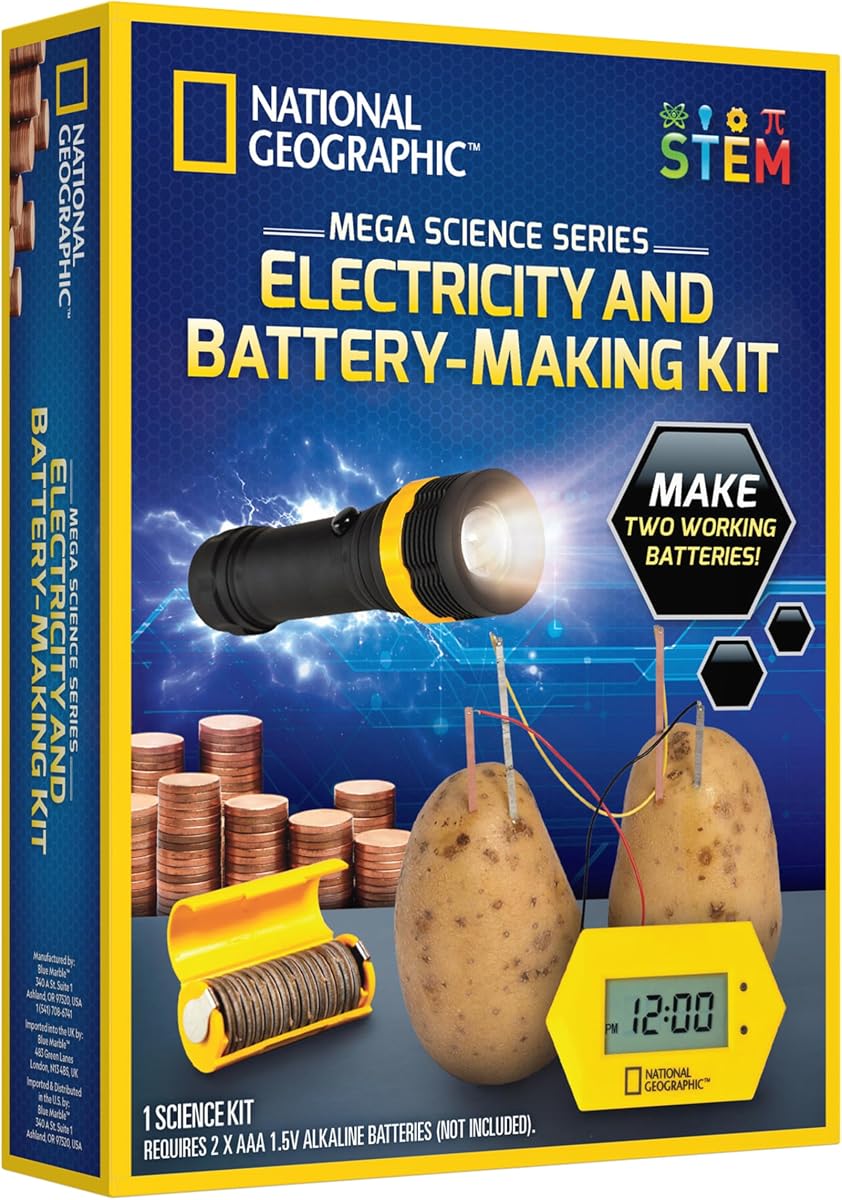
This kit teaches battery creation through potato and coin experiments. It offers two distinct STEM projects for diverse learning.
We may earn a commission when you buy through this link, at no additional cost to you.
Easy instructions allow immediate start. Kids build a potato clock and a penny flashlight to understand voltage generation.
The project count is low but focused. This ensures mastery of battery fundamentals without overwhelming complexity for beginners.
Ideal for introducing electrochemistry concepts. It turns common household items into powerful learning tools for curious kids.
Uses food and coins to demonstrate battery chemistry, making abstract concepts tangible for young learners.
With just two projects, children can complete the kit quickly and feel a strong sense of achievement.
We may earn a commission when you buy through this link, at no additional cost to you.
Choosing the right electricity learning kit requires evaluating several factors to match your child's age, interests, and educational needs.
Different kits target specific age groups, with some designed for 8+ and others for high school students. Younger children need simple snap-on components while teens can handle complex wiring. Always check the recommended age range to ensure the difficulty level matches their experience.
Select kits labeled for your child's age to maximize engagement and safety.
Kits with more projects offer better long-term value. Look for a mix of series circuits, parallel circuits, and electromagnetism experiments to keep learning fresh. More variety means the kit can grow with the student over several months.
Prioritize kits with 50 or more projects to ensure sustained interest and learning.
Clear instructions are vital for independent learning. Manuals with detailed illustrations or video support help students troubleshoot issues on their own. Without clear guidance, frustration can lead to abandoning the kit entirely.
Look for manuals that explain not just steps but also the science behind them.
Safety is paramount when dealing with electricity. Kits should use low voltage and have insulated wires to prevent shocks. Components like fuses or thermal limits protect both the user and the equipment during experiments.
Ensure all components are labeled safe for children and operate within safe voltage ranges.
A good kit includes storage to keep parts organized. Boxes with individual slots prevent loss and make cleanup easy. Without storage, loose wires and small components can quickly become a mess.
Choose kits with sturdy storage cases to maintain organization and extend the kit's life.
Some kits require extra tools like screwdrivers or pliers while others provide all necessary components. Kits needing no tools are ideal for younger users. Ensure you have any required batteries or tools before starting.
Prefer kits that include all necessary tools to avoid hidden costs or delays.
Beyond building, a good kit explains scientific principles like Ohm's law or energy conversion. This theoretical backing turns play into education. Look for manuals that connect experiments to real-world physics.
Focus on kits that blend hands-on building with clear theoretical explanations.
Plastic components should be robust enough to withstand repeated assembly. Check reviews for reports of breaking clips or loose connections. Durable kits offer better value over time compared to fragile ones.
Select kits with reputation for durability to ensure they last through multiple learning phases.
Start by reviewing the manual thoroughly before assembling any components. Understand the purpose of each part like resistors, switches, and batteries. This preparation minimizes confusion during the actual building process.
Always connect circuits correctly before attaching power sources. Double-check polarity for batteries and ensure all wires are secure. This prevents short circuits that could damage components or cause overheating.
Store the kit in a dry, cool place after use. Disassemble projects completely and return each part to its designated spot. Proper care extends the lifespan of the components and keeps them ready for future experiments.
Most kits do not include batteries to save on shipping weight. Always check the product details to see if AA or AAA batteries are required. You will typically need to purchase them separately before starting experiments.
High school kits are generally too complex for younger kids. The concepts involved like magnetism and advanced circuits require maturity. It is safer to start with age-specific kits designed for 8+ years to ensure engagement.
With proper care, components can last for years. Avoid leaving batteries in the holders when not in use to prevent leakage. Reassemble the kit carefully to avoid bending wires or breaking plastic connectors.
Many manufacturers offer satisfaction guarantees or replacement parts. Check the seller policies before purchasing to understand the warranty terms. Contacting support can help resolve issues with damaged components quickly.
For younger children, adult supervision is highly recommended even with safe kits. Older teens can work independently but should still follow safety guidelines. Adult oversight ensures safe handling of electrical components.
Yes, many teachers use these kits for science classes. They fit well within STEM curriculum requirements and support group work. Check the kit content to align with your specific teaching objectives.
We reviewed ten top-rated kits ranging from budget basic sets to premium advanced models. Our top picks like the National Geographic Circuit Kit offer unmatched project variety and safety.
When choosing, prioritize age appropriateness and instructional clarity. A kit that matches your child's skill level ensures a rewarding learning experience without unnecessary frustration.
Remember to verify current prices and availability before buying. Kits may vary by region or seller, so checking recent details guarantees you get the best value for your investment.