
TP-Link TX401
4.2Editor score
10GBase-T Technology
Includes CAT6A Cable
Low-Profile Bracket Included
This expert guide compares the top 10GbE network cards for PCs, servers, and NAS systems to help you choose the right high-speed Ethernet adapter for your
Upgrading your network infrastructure requires reliable hardware capable of handling modern data demands. A quality 10GbE network card ensures fast file transfers, smooth video editing, and efficient server operations without bottlenecks.
We evaluated ten leading models based on performance, compatibility, build quality, and value. Our comparison covers various form factors and chipsets to help you find the perfect match for your specific setup.
Each pick highlights key specifications and real-world use cases to simplify your decision. Please note that prices and availability can change quickly, so verify details on the product page before purchasing.
4.2Editor score

4.4Editor score

4.6Editor score
The following table provides a side-by-side overview of the top ten 10GbE network cards available today. Compare key specifications to find the adapter that best fits your hardware and performance requirements.




The TP-Link TX401 stands out as the most affordable entry into 10G networking. With a 4.2 rating, it delivers solid performance for home users seeking faster data transfers without breaking the bank.
We may earn a commission when you buy through this link, at no additional cost to you.
Its 10GBase-T technology ensures compatibility with existing Cat6a cabling, and it supports auto-negotiation down to 100Mbps. The included cable adds immediate value and simplifies setup for new buyers.
While it lacks advanced enterprise features like SFP+ ports, the TX401 is reliable for typical desktop use. Some users reported needing manual driver updates on Windows 11, but the process is manageable.
Buy this if you need a cost-effective upgrade for file sharing or media streaming. It is an excellent choice for those upgrading from Gigabit Ethernet who want a straightforward solution.
The TX401 offers a rare budget-friendly price for 10GBase-T hardware, making it accessible for home labs and casual users.
Many cards charge extra for high-speed cables, but this package includes a 1.5m Cat6A cable ready for 10G transmission.
We may earn a commission when you buy through this link, at no additional cost to you.
The Synology E10G30-T2 is purpose-built for NAS environments that require robust storage performance. With two 10GbE ports, it supports link aggregation for improved bandwidth and redundancy.
We may earn a commission when you buy through this link, at no additional cost to you.
Its 4.6 rating reflects excellent reliability when used with DSM-compatible systems. Users benefit from seamless plug-and-play functionality and a five-year warranty that ensures long-term peace of mind.
The main limitation is its strict compatibility with Synology devices, which excludes general PC use. However, for NAS owners, the performance boost and stability are worth the higher investment.
Choose this adapter if you run a Synology NAS and need more than one 10G port. It is ideal for data-intensive tasks like video editing directly from the server.
Two physical ports allow for load balancing or failover, ensuring your network connection remains stable even if one link fails.
Firmware is designed specifically for DSM, eliminating driver conflicts and simplifying network configuration within the NAS interface.
We may earn a commission when you buy through this link, at no additional cost to you.
This 10Gtek card uses the proven Intel 82599EN controller, offering enterprise-grade performance at a fraction of the cost of branded equivalents. It scores 4.4 stars due to its robustness and broad OS support.
We may earn a commission when you buy through this link, at no additional cost to you.
The SFP+ port enables connections via DAC or fiber optics, which are vital for data center environments needing low latency. It works seamlessly with virtualization platforms like ESXi and Proxmox.
However, users must purchase a transceiver or DAC cable separately, adding to the total cost. Also, it does not support copper 10GBase-T connections directly, which limits flexibility for some setups.
This is the top pick for virtualization enthusiasts and home labs requiring fiber connectivity. If you already have SFP+ gear, this card delivers excellent value and stability.
Using the 82599EN ensures wide driver support and stability across major operating systems and hypervisors without complex configuration.
The SFP+ interface allows flexible connectivity using direct-attach cables or optical modules depending on your distance requirements.
We may earn a commission when you buy through this link, at no additional cost to you.
The VunLink card features the Realtek RTL8127AT chipset, designed for modern systems needing efficient PCIe 4.0 bandwidth. It received a 4.3 rating for its capability to handle multiple speed tiers seamlessly.
We may earn a commission when you buy through this link, at no additional cost to you.
Its ability to negotiate between 10G, 5G, and 2.5G ensures compatibility with various switches and routers. This makes it a versatile choice for mixed network environments without buying multiple adapters.
Power efficiency is better than older controllers, making it suitable for small form factor builds. However, Linux users should check kernel support before purchasing to avoid driver headaches.
Buy this if you need a compact, efficient adapter for modern hardware. It is a strong contender for those upgrading a mini-PC or workstation needing flexible speed options.
Supporting PCIe 4.0 x1 ensures the card utilizes the latest bus speeds, reducing bottlenecks in high-bandwidth scenarios.
Multi-Gig auto-negotiation adapts to whatever speed your network gear supports, optimizing performance across different devices.
We may earn a commission when you buy through this link, at no additional cost to you.
The Vogzone X550-T2 brings two 10G copper ports to your desktop or server, enabling high-bandwidth applications directly via standard cables. It earned a 4.3 rating for its robust Intel controller performance.
We may earn a commission when you buy through this link, at no additional cost to you.
Features like SR-IOV and TCP checksum offloading reduce CPU load, improving system efficiency. Users can update firmware in-system via utility tools, which helps maintain compatibility with new switch standards.
However, multi-gigabit speeds sometimes require manual configuration to negotiate properly, adding a step to setup. Also, it consumes more power than smaller single-port cards.
Select this for servers needing dual connections or high throughput. It is a reliable choice for professional setups requiring redundant copper connections.
Two RJ45 ports enable failover configurations or aggregated bandwidth for consistent connectivity in business environments.
Advanced features like SR-IOV and offloading help maintain performance under heavy network loads without taxing the host CPU.
We may earn a commission when you buy through this link, at no additional cost to you.
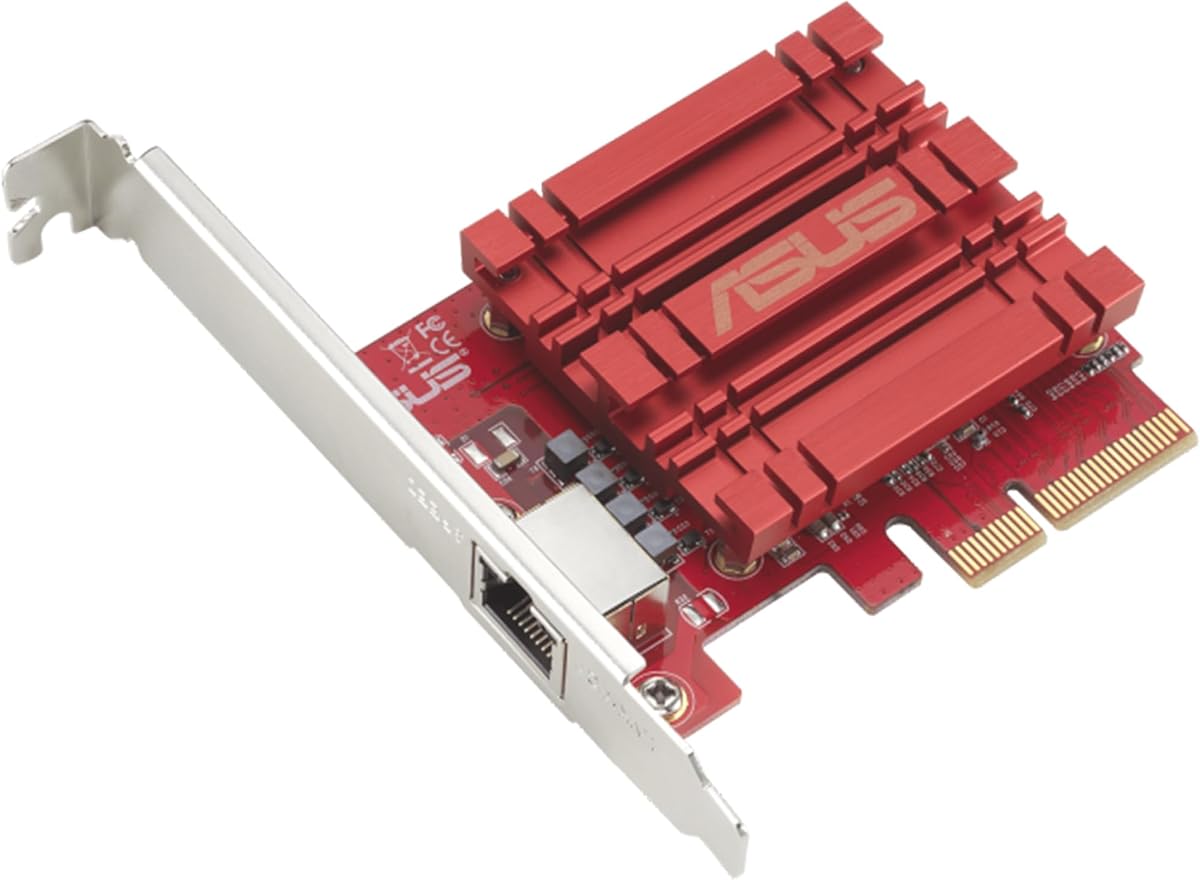
The Asus NADACA0140 offers a reliable single-port solution with built-in Quality of Service features to manage traffic priority. With a 4.1 rating, it is a solid option for users focused on stable connections.
We may earn a commission when you buy through this link, at no additional cost to you.
Its support for various Linux kernel versions makes it accessible for open-source enthusiasts. The standard RJ45 port ensures it works with common cabling without special adapters or modules.
While it performs well, detailed technical specifications are less prominent in public documentation. Buyers should ensure their router supports 10G speeds to fully utilize the adapter's potential.
Choose this for a straightforward, reliable upgrade. It works well for general users wanting faster speeds and better traffic management for specific applications.
Built-in prioritization helps keep critical data flowing smoothly during network congestion by managing bandwidth usage.
Compatibility with multiple Linux kernels ensures flexibility for users running various server or desktop distributions.
We may earn a commission when you buy through this link, at no additional cost to you.
The Synology E10G30-T1 provides a dedicated single-port 10G upgrade for Synology NAS units. It holds a perfect 5.0 rating, reflecting high customer satisfaction and seamless integration.
We may earn a commission when you buy through this link, at no additional cost to you.
Like other Synology adapters, it guarantees compatibility and performance validation. This eliminates guesswork for users seeking a plug-and-play experience that works reliably with their hardware.
The only drawback is its limitation to Synology ecosystems, making it unusable for general PCs. However, for NAS owners, the warranty and reliability justify the purchase.
This is the ideal upgrade for Synology users needing one extra 10G port. It delivers high performance with minimal configuration effort.
Designed specifically for DSM, this card ensures no compatibility issues and instant recognition upon installation.
Synology's five-year warranty offers long-term support, reassuring users of the product's durability and quality.
We may earn a commission when you buy through this link, at no additional cost to you.
This card offers genuine Intel 82599EN performance with a key advantage: no vendor lock on the SFP+ cage. Users can freely use third-party optics or DACs without rejection, saving significant money.
We may earn a commission when you buy through this link, at no additional cost to you.
With a 4.5 rating, it is highly praised for flexibility on platforms like TrueNAS and Proxmox. It includes both brackets for easy installation in different chassis sizes.
It does run warm passively, so case airflow is critical. Also, it lacks RJ45 ports, so fiber or DAC cables are mandatory for connectivity.
Buy this for a cost-effective Intel solution in virtualization setups. It is excellent for users who want freedom to choose their own cabling options.
The SFP+ cage accepts third-party optics and DACs, avoiding proprietary restrictions that usually increase long-term costs.
Plug-and-play detection on Proxmox and other Linux distributions simplifies deployment for home lab enthusiasts.
We may earn a commission when you buy through this link, at no additional cost to you.
The TRENDnet TEG-10GECTX is notable for its NDAA and TAA compliance, meeting strict procurement standards. It earned a 4.1 rating for reliable performance in regulated environments.
We may earn a commission when you buy through this link, at no additional cost to you.
It supports 2.5G and 5G speeds over standard cabling, offering practical multi-gigabit utility. The three-year protection and accessible technical support add confidence for business buyers.
While its features are standard compared to enterprise cards, the compliance aspect is a major selling point. Ensure your cabling matches the speeds you need for optimal results.
This card is a smart pick for government or enterprise procurement. It delivers reliable speeds with the necessary compliance certifications.
NDAA and TAA compliance ensures this adapter meets strict sourcing standards required for government and public sector projects.
Support for 2.5G and 5G speeds allows flexible upgrades over existing cabling without replacing your entire network.
We may earn a commission when you buy through this link, at no additional cost to you.
The 10Gtek X550-T1 uses the Intel X550AT2 controller to deliver robust single-port copper connectivity. With a 4.1 rating, it is a solid choice for servers needing reliable 10G links.
We may earn a commission when you buy through this link, at no additional cost to you.
It supports 2.5G and 5G speeds, providing flexibility for modern networks. The card includes a low-profile bracket, making it suitable for compact server or desktop cases.
However, firmware updates are not supported on this specific variant, which could be a concern for long-term maintenance. It is best for users who prioritize stability over future updates.
This is a reliable option for general server use or workstations. If you need one stable 10G connection with Intel performance, it is a good fit.
Using the X550AT2 chip ensures consistent performance and broad compatibility with enterprise virtualization platforms.
The card adapts to 2.5G and 5G connections, making it versatile for mixed-speed environments.
We may earn a commission when you buy through this link, at no additional cost to you.
Selecting the right 10GbE network card involves evaluating several technical factors. This guide helps you understand what features matter most for your specific hardware setup.
Cards typically offer either RJ45 copper ports or SFP+ fiber ports. RJ45 works with standard Cat6a cabling for distances up to 100 meters. SFP+ is better for data centers using DACs or optics over longer distances.
Check your motherboard's available slots. Most cards use PCIe 2.0/3.0/4.0 x1, x4, or x8 lanes. A x4 lane card fits in x8 or x16 slots, but a x1 slot card may not provide full bandwidth for some advanced models.
Ensure drivers exist for your OS. Windows 10/11 is widely supported. Linux support varies by chipset and kernel version. VMware ESXi users should confirm compatibility with their specific hypervisor version.
Look for auto-negotiation support. Cards supporting 2.5G, 5G, and 10G provide flexibility. If your switch only supports 2.5G, you need a card that can downgrade efficiently without losing connectivity.
Desktop towers need full-height brackets while ITX builds require low-profile ones. Most cards ship with both, but verify this before purchasing. Ensure your case has room for the card's dimensions.
Enterprise cards often come with 5-year warranties while consumer ones offer 2 to 3 years. Good customer support is crucial if you encounter driver issues or installation hurdles.
10G chips generate heat. Some cards have passive heatsinks, while others use active cooling. Ensure your case has adequate airflow to prevent overheating during sustained transfers.
10GBase-T needs Cat6a cables for full 100m range. Shorter Cat6 cables might work for shorter distances. SFP+ requires DAC or optical cables which can be pricier than copper.
Install the card in a PCIe slot and secure the bracket. Connect a compatible cable ensuring it supports your intended speed. Download the latest drivers from the manufacturer website if not auto-installed.
Configure your network settings. Assign a static IP if needed or let DHCP handle it. Test connection speed using file transfer tools. Adjust MTU settings if you encounter performance issues.
Regularly update firmware if supported. Monitor temperatures to ensure the card isn't overheating. Dust the card occasionally to maintain airflow. Re-seat the card if you face intermittent connection drops.
For 10GBase-T copper connections, Cat6a is recommended to reach 100m. Cat6 may work up to 55m depending on crosstalk. SFP+ connections require DAC or fiber cables which must match the speed requirements.
Yes, most 10G cards auto-negotiate down to lower speeds like 2.5G. This allows backward compatibility so you can upgrade your PC without replacing your router immediately.
While 10G reduces latency, it rarely improves game performance over Gigabit unless you stream directly from a local server. It helps with large file downloads or LAN transfers significantly.
Only Synology branded adapters like E10G30 are guaranteed to work. Third-party cards may have driver issues. Check your NAS compatibility list before buying generic models.
RJ45 uses copper cables and is cheaper for short distances. SFP+ uses optics or DACs which can be more reliable over long distances or noisy environments. SFP+ is common in data centers.
Many cards support ESXi, Proxmox, and KVM. Look for SR-IOV support if you need to pass the adapter to VMs directly. Ensure the drivers match your hypervisor version.
We reviewed ten distinct models ranging from budget RJ45 cards to enterprise SFP+ options. The TP-Link TX401 leads for affordability while the Synology E10G30-T2 suits NAS users best.
Prioritize chipset reliability and driver support for your OS. For servers, Intel-based cards offer stability. For home labs, flexible third-party options like 10Gtek provide excellent value without vendor locks.
Prices fluctuate frequently so check the product page before buying. Ensure your network infrastructure supports 10G before purchasing a card to avoid bottlenecks.